
Eco-friendly inks are packaging inks formulated to reduce environmental impact, health risks, and harmful emissions while maintaining reliable print performance. They are designed with lower VOCs, safer raw materials, and better end-of-life compatibility in mind, especially for modern packaging systems that face increasing sustainability and safety requirements.
The problem is that inks are often treated as a minor detail in packaging decisions. Materials get upgraded, recycling claims get added, but ink chemistry is left untouched. Conventional inks can release VOCs during printing, interfere with recycling streams, and raise food safety concerns through migration. These issues rarely show up immediately, but they accumulate over time through compliance pressure, production constraints, and brand risk.
Eco-friendly inks address this gap by changing how packaging inks are formulated, selected, and used. Instead of focusing only on color and speed, they consider emissions, food contact safety, regulatory fit, and long-term sustainability. Understanding how these inks work, where they perform best, and how to choose them correctly is now a practical requirement rather than an optional upgrade in sustainable packaging.
What Are Eco-Friendly Inks in Packaging?
When people hear the phrase ‘eco-friendly inks,’ their first reaction is often vague. It sounds good, but also a little abstract. In packaging, the term has a particular meaning. It is not just about being less harmful in theory. It is about how inks behave during printing, during use, and after disposal.
In a practical sense, Eco-Friendly Inks in packaging are printing inks that cut environmental and health impacts while still holding up on real production lines. The shift starts inside the formula: fewer aggressive solvents, more water or radiation-curable systems, more bio-based or renewable raw materials, and pigments that avoid substances nobody wants to defend in a compliance meeting. The outcome is not just a nicer label on the container, but different emissions, a different safety profile, and a different story at end of life.
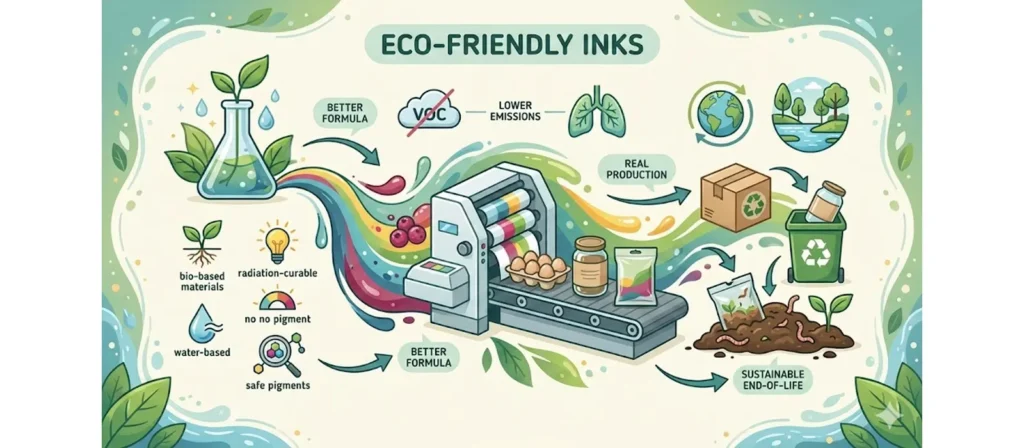
In practical terms, these inks rely on safer carriers and binders, lower levels of volatile organic compounds, and pigments that are less likely to migrate or persist in the environment. They are developed with real packaging constraints in mind. Speed, adhesion, color strength, and cost still matter. Sustainability is not added on top. It is built into the formulation.
What makes this topic complicated is that “eco-friendly” is not a single formula. It is a direction. Different inks solve different problems, and no single ink works for every packaging material or application. That is why context matters so much in packaging.
How Eco-Friendly Inks Differ From Conventional Inks
On press, conventional inks and Eco-Friendly Inks seem to do the same thing: carry color, transfer to the substrate, dry or cure, and stay there. The real gap shows up when you look at the chemistry, the emissions during printing, and how each option behaves through the life cycle of the packaging. One way to make that gap less abstract is to place the two side by side and see what actually changes.
| Aspect | Eco-Friendly Inks | Conventional Inks |
|---|---|---|
| Carrier system | Water-based, plant-based oils, or non-solvent curing systems | Petroleum-based solvents |
| VOC emissions | Low to near-zero VOC release | High VOC emissions during drying |
| Drying and curing | Air drying, heat-assisted drying, or UV/EB curing | Solvent evaporation |
| Food contact safety | Formulated to reduce migration risk | Higher risk of component migration |
| Environmental impact | Lower emissions and easier compliance | Higher environmental footprint |
| Press control requirements | Requires tighter process control | More forgiving under varied conditions |
| End-of-life considerations | Designed with recycling or composting in mind | Limited consideration for disposal impact |
Why are eco-friendly inks crucial for sustainability?
Sustainability in packaging is no longer just about swapping plastic for paper or printing a recycling icon. It now stretches across the whole system: what materials are used, how they behave on press, what they release into the air, and what happens when the pack becomes waste. Eco-Friendly Inks sit right in the middle of that chain. They influence factory emissions, worker exposure, recyclability, odor, and even how believable a “green” claim feels once someone looks beyond the headline.
In a typical print plant, a noticeable share of environmental impact comes from solvents flashing off during drying. Conventional inks send VOCs into the air and demand heavy ventilation, abatement equipment, and extra energy just to stay safe and compliant. When those same jobs are run with Eco-Friendly Inks that sharply cut VOCs, the footprint shifts: air quality improves, energy tied to exhaust and treatment can fall, and the sustainability profile of every printed square meter quietly looks better on a real emissions report.
Then there is the question of what happens after the pack has done its job. Recyclers and certifiers do not just see board, film, or foil; they see an entire structure, including the ink film. If that layer causes odor, contamination, or trouble in deinking, the value of a “recyclable” substrate drops quickly. Eco-Friendly Inks are formulated to fit more cleanly into recycling, energy recovery, or composting systems and to avoid substances that raise questions in food, cosmetics, or baby products, turning the printed surface into an asset instead of a weak point in your sustainability story.
Main Types of Eco-Friendly Inks for Packaging
In the packaging world, most conversations about Eco-Friendly Inks end up circling a few big families: water-based systems, soy or vegetable-based inks, UV and EB-curable low-VOC inks, and broader bio-based or renewable-resource formulations. Around the edges, a small group of experimental chemistries is starting to show up as pilot projects for brands that want something even bolder. The names can sound similar in supplier brochures, but their behavior on real substrates is very different. Understanding these categories helps avoid the common mistake of assuming one “green” ink works everywhere.
Water-Based Eco-Friendly Inks
Water-based inks are often the first category people associate with eco-friendly inks, and for good reason. They replace most organic solvents with water as the primary carrier, significantly reducing VOC emissions during printing and drying. In packaging, this makes them especially common in paper-based and cardboard applications.
These inks perform well on absorbent substrates such as kraft paper, corrugated board, and uncoated cartons. They are widely used in food packaging, retail packaging, and secondary packaging where odor, safety, and indoor air quality matter. The trade-off is control. Drying speed depends heavily on airflow, temperature, and substrate absorption. Poor press control shows quickly.
Water-based eco-friendly inks are not universal solutions, but when matched correctly, they offer one of the clearest sustainability gains with relatively mature technology.
Soy-Based and Vegetable-Based Inks

Soy-based and vegetable-based inks shift the sustainability focus to raw materials. Instead of petroleum-derived oils, these inks use renewable plant oils as carriers. The environmental benefit comes from resource renewability and, in many cases, easier de-inking during recycling.
In packaging, these inks are commonly used for paperboard, folding cartons, and printed paper packaging where color richness and sharp detail are important. They tend to produce strong, clean colors, which is why they are often associated with brand-heavy packaging.
However, plant-based does not automatically mean food-safe or low migration. Formulation still matters. These inks must be evaluated carefully for food-grade packaging, especially when direct contact or heat exposure is involved.
UV and EB-Curable Low-VOC Inks
UV and EB-curable inks approach sustainability from a different angle. Instead of drying through evaporation, they cure instantly when exposed to ultraviolet light or electron beams. This process releases little to no VOCs and delivers excellent durability.
These inks are widely used in flexible packaging, labels, and high-speed packaging lines where precision and resistance matter. From a sustainability perspective, their strength lies in efficiency. Fast curing reduces energy waste, ink usage, and production errors.
The challenge is balance. While emissions are low, the formulations are more complex, and recyclability must be assessed carefully depending on substrate and curing chemistry. UV and EB inks are eco-friendly in use, but they require thoughtful system-level evaluation.
Bio-Based and Renewable-Resource Inks
Bio-based inks go beyond carrier oils and look at the full formulation. Pigments, binders, and additives are increasingly sourced from renewable or less toxic inputs. These inks are often positioned for brands that want deeper alignment with sustainable packaging principles.
In practice, bio-based eco-friendly inks are still developing. Performance can vary, and availability may be limited depending on region and supply chain. They are most often used in controlled packaging environments where sustainability messaging and material transparency are priorities.
These inks represent intent more than dominance. They show where the industry is moving, not where it has fully arrived.
Emerging Innovations
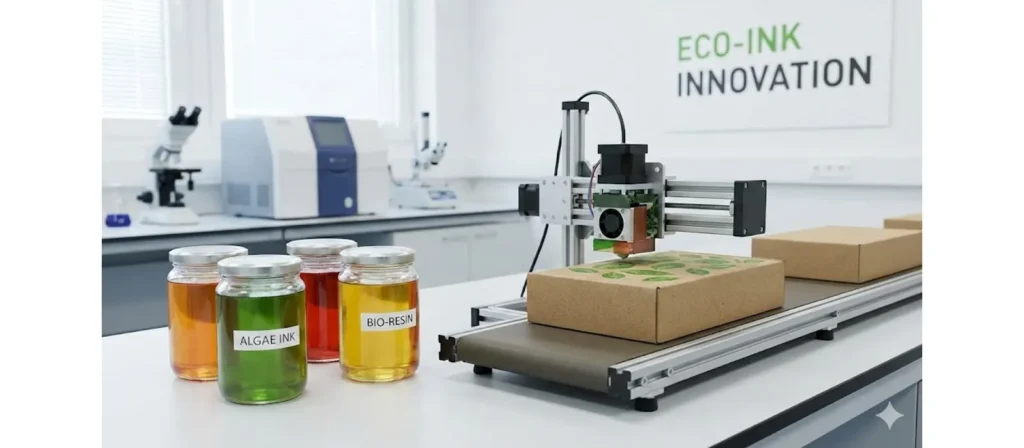
At the edges of today’s market, a quieter set of experiments is unfolding under the broad label of emerging eco-inks. These range from algae-derived components and new bio-resin systems to inks designed for easier composting or for cleaner separation in advanced recycling. Most of these technologies do not yet show up in everyday packaging jobs, but they hint at where the next round of Eco-Friendly Inks might come from.
Innovation in eco-friendly inks is ongoing, and much of it is quiet. Lower-migration pigment systems, improved compostability compatibility, and hybrid curing methods are gradually entering commercial use. Some developments focus on making inks more recyclable. Others aim to reduce total ink coverage without sacrificing visual impact.
What stands out is that eco-friendly inks are no longer experimental side projects. They are being integrated into mainstream packaging development, driven by regulation, brand pressure, and operational cost control.
The Advantages of Using Environmentally Friendly Inks for Packaging
Using environmentally friendly inks in packaging is rarely about a single benefit. It is usually a combination of small, practical advantages that add up over time. Some are technical. Some are regulatory. Some only become obvious after problems stop happening.
Suitable for food-grade packaging.
One of the most immediate advantages of eco-friendly inks is their suitability for food-grade packaging. Traditional packaging inks can contain components that migrate under heat, pressure, or prolonged storage. This is not always visible, but it is a constant concern in food contact applications.
There isn’t much room for guesswork here. Any ink that sits on or near packaging for snacks, drinks, baby food, or ready meals has to behave under strict migration limits, low odor expectations, and detailed documentation. In that context, Eco-Friendly Inks designed for food-grade use are built from the start with safer components, low migration behavior, and a clear paper trail in mind.
Environmentally friendly inks are often formulated with migration control as a core requirement. Lower solvent content, safer binders, and cleaner pigment systems reduce the risk of unwanted transfer. This makes them more compatible with food packaging standards and safer for long-term use, especially in direct or indirect food contact scenarios.
Near-zero VOCs
Traditional solvent-heavy inks push a lot of volatile organic compounds into the pressroom air. That means extraction systems humming all day, more energy for ventilation, and a constant balancing act between productivity and exposure limits. When a line moves to environmentally friendly inks with near-zero VOCs, the atmosphere in the plant literally changes. Air feels cleaner, odor drops, and the conversation with environmental health and safety teams shifts from “how do we keep this under control” to “how much have we already reduced.” For companies reporting emissions or aiming at science-based targets, the move to Eco-Friendly Inks with very low VOCs is one of the levers that can be quantified and defended.
Lower Environmental Footprint
The environmental footprint of packaging inks goes beyond emissions. It includes raw material sourcing, energy consumption during printing, and end-of-life behavior.
Eco-friendly inks tend to score better across these areas. Renewable inputs reduce dependence on fossil resources. Efficient curing systems reduce energy waste. Cleaner formulations interfere less with recycling or composting processes. None of these changes are dramatic on their own, but together they shift packaging inks closer to sustainable packaging goals.
Less health and safety risks
Pressrooms that rely heavily on solvent-based systems carry specific risks: flammable liquids, strong odors, and the possibility of worker exposure to harsh chemicals during handling and cleaning. Environmentally friendly inks are engineered to dial down that risk. Lower VOCs mean less inhalation exposure. Reduced use of hazardous substances eases the burden on protective equipment, storage rules, and emergency procedures. The work doesn’t suddenly become risk-free, but the baseline becomes more manageable. Over time, that means fewer complaints, fewer “near misses,” and a more stable safety profile for the entire printing operation.
Excellent print quality
There is still a quiet suspicion in some packaging teams that “eco-friendly” automatically means dull colors and fragile print. That used to be a fair worry in the early days. It is much less accurate now. Modern Eco-Friendly Inks can deliver strong color, sharp barcodes, and good resistance to rubbing, folding, and filling, as long as they are matched properly to the substrate and process. On the shelf, most shoppers will not spot any difference without a label telling them. In some cases, tone control and consistency even improve because plants are forced to tighten up process control when they introduce new ink systems. So the trade-off is not “green or good-looking,” it’s “is this particular ink tuned well enough for this line?”
Regulatory compliance
Regulation around chemicals in packaging is moving in one direction: tighter. Restrictions on solvents, heavy metals, photoinitiators, and substances of very high concern keep expanding, region by region. Running purely conventional inks in this environment can feel like walking across a field of hidden mines. Environmentally friendly inks are formulated with these rules in mind from the beginning, and suppliers know they will be asked for migration data, substance lists, and declarations. That makes it much easier for brands to keep up with changing laws without freezing every time a new regulation appears. In a sense, choosing Eco-Friendly Inks is also choosing fewer regulatory surprises.
Positive consumer perception and brand image
Most consumers will never read a technical data sheet, but many of them read packaging claims, and a growing number care about what those claims really mean. When a brand says it is serious about sustainable packaging, details matter: recycled content, certified fiber, lighter structures, and yes, the inks as well. Being able to say that a pack is printed with environmentally friendly inks, and to back that up when questioned, gives the sustainability story more depth. It feels less like a slogan and more like a series of concrete choices. Over time, this kind of consistency is what shapes trust. A shopper might not consciously think “these Eco-Friendly Inks are impressive,” but they pick up on the pattern: this brand’s packaging feels thoughtful, not just decorative.
How to Choose the Right Eco-Friendly Inks for Your Packaging
Choosing eco-friendly inks for packaging is rarely a matter of picking the “greenest” option on paper. The real decision happens where materials, processes, regulations, and cost intersect. An ink that works perfectly in one setup can quietly fail in another. This part is about reducing that gap.
Ink, Substrate, and Process Fit
Ink selection always starts with what you are printing on and how you are printing it. Paper, cardboard, plastic films, and multilayer laminates behave very differently, and eco-friendly inks respond to these differences more sharply than conventional systems.
Paper and board for corrugated, cartons, and mailers pull you toward water-based and some bio-based Eco-Friendly Inks, especially in flexo and gravure. Offset on cartons opens the door to soy and vegetable-based systems. Films and foils used for labels and flexible packaging might point you toward carefully selected UV or EB-curable inks that can anchor well and cure fast without flooding the plant with solvents. If the line is digital, you’re suddenly in the world of specific inkjet or toner chemistries and need to work inside whatever eco-focused range the vendor offers.
Food Contact and Regulatory Fit
Compliance is not optional in packaging, and eco-friendly inks are no exception. Food contact regulations vary by region, and the same ink formulation may be acceptable in one market and restricted in another.
For food packaging, migration limits matter more than labels. Ink suppliers should be able to provide documentation that aligns with regional standards and intended use conditions. Temperature, storage time, and direct versus indirect contact all affect compliance. Sustainable packaging only works when regulatory reality is part of the decision from the beginning.
Color, Durability, and Curing Performance
After the substrate and compliance filters, performance is where the real negotiations start. The question is not “does it print at all?” but “does it print well enough, consistently enough, under real production conditions?” A greener ink that forces you to slow the press to half speed or produces dull, unstable color will quickly lose its charm.
So the focus shifts to a few very practical checks: can this ink hit the brand’s color targets without endless tweaking; does it survive filling, sealing, and transport without scuffing or fading; and can it cure or dry at the line speeds you actually run, with the equipment you already have? Trials and controlled tests matter here more than promises. A short pilot on a real job often tells you more than a thick brochure ever will.
Cost, Supply, and Long-Term Reliability
Only after the ink has passed the technical and compliance checkpoints does it really make sense to argue about price. At that point, you’re not comparing “cheap vs expensive” in isolation; you’re comparing total cost and risk: ink price, waste, downtime, compliance workload, and long-term stability of the supply.
Some Eco-Friendly Inks will cost more per kilo; that part is not surprising. The real question is whether that extra cost is offset by lower VOC treatment, fewer safety measures, smoother audits, or reduced waste and reprints. In some plants, the numbers add up quickly, and the premium looks modest; in others, with tight margins and less regulatory pressure, the business case is thinner and might require phasing the change by line or product category.
Choosing the right eco-friendly ink means looking beyond short-term savings. Availability, lead times, and supplier transparency become part of sustainability, whether intended or not. A sustainable packaging strategy that depends on unstable inputs creates new risks instead of solving old ones.
Conclusion
Eco-friendly inks are no longer a side topic in packaging. They sit at the intersection of sustainability, food safety, regulation, and real-world print performance. What matters is not whether an ink is labeled “green,” but whether it fits the substrate, the printing process, and the regulatory environment it operates in.
Throughout this article, the focus has stayed on practical differences rather than ideal claims. Eco-friendly inks vary widely in formulation and behavior. Some reduce emissions, some improve food contact safety, some simplify compliance, and others mainly align with long-term sustainability goals. None of them work in isolation.
Choosing eco-friendly inks in packaging is less about chasing trends and more about making fewer mistakes. When inks are selected with context in mind, they quietly reduce risk, simplify operations, and support sustainable packaging without disrupting performance. That quiet consistency is often the real advantage.