A good salad bowl size should match the way the food is built and served. A bowl that is too small makes mixing messy and increases spill risk during delivery. A bowl that is too large can make portions look skimpy, waste shelf space, and raise packaging costs without improving the eating experience.
In this guide, you will learn how to read common bowl size terms, how to match capacity to real fill, and how material choice changes performance with cold salads, warm grains, and saucy toppings. The goal is simple: help you pick a salad bowl size that fits your menu, your service style, and your customers.
Why choosing the right salad bowl size matters
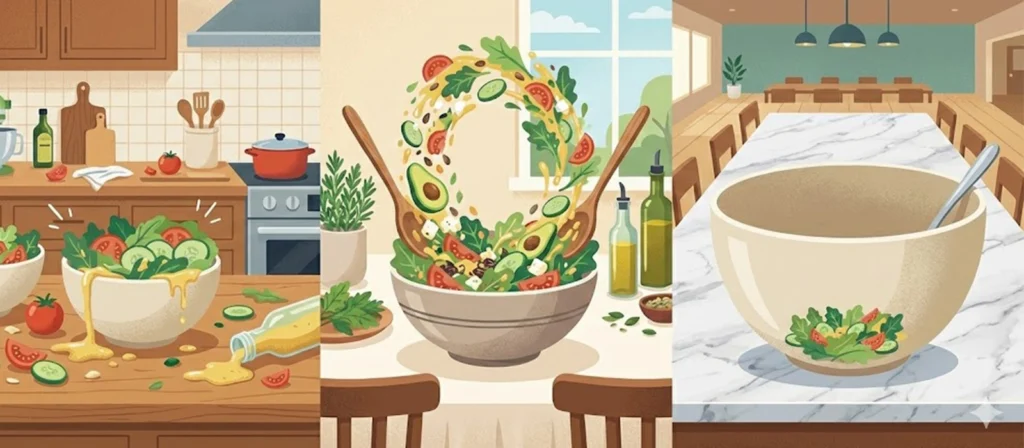
Choosing the right salad bowl size affects far more than how much food fits inside. It influences food quality, customer satisfaction, and daily operations across preparation, storage, and delivery. Below are the key reasons this decision deserves careful attention.
- Food presentation and visual balance
A well matched salad bowl size helps ingredients look abundant and well layered rather than crowded or sparse. Proper spacing keeps greens upright, toppings visible, and sauces evenly distributed, which directly shapes how customers judge freshness and value. - Ease of mixing and eating
Salads are often mixed before eating. When the bowl is too small, tossing becomes difficult and messy. A suitable salad bowl size allows ingredients to be combined evenly without spills, improving the overall eating experience. - Portion control and consistency
Using a consistent salad bowl size helps standardize portions across locations and shifts. This supports menu accuracy, nutrition transparency, and predictable food costs, especially for operations with multiple staff members preparing salads. - Packaging performance during transport
For takeaway and delivery, the right salad bowl size reduces movement inside the container. This lowers the risk of crushed greens, leaked dressing, and lid failure during handling or transit. - Cost efficiency and inventory management
Oversized bowls increase material usage, storage space, and shipping volume. Undersized bowls may require double packing or cause remakes. Choosing the correct salad bowl size helps balance packaging cost with operational efficiency. - Customer perception of value
Customers often judge portion value visually before tasting. A salad that fills the bowl appropriately feels more satisfying, even when the actual weight matches the menu description. The right salad bowl size helps align expectations with reality.
In short, salad bowl size is a functional decision with visual, operational, and financial consequences. Getting it right supports both the food and the business behind it.
What are the common salad bowl sizes
Understanding common salad bowl size options helps you compare products accurately and avoid relying on vague labels like small or large. In foodservice and takeaway packaging, salad bowl size is usually defined by capacity in ounces or milliliters, but each size also implies a typical use scenario. Below are the most widely used salad bowl sizes, explained in practical terms rather than just numbers.
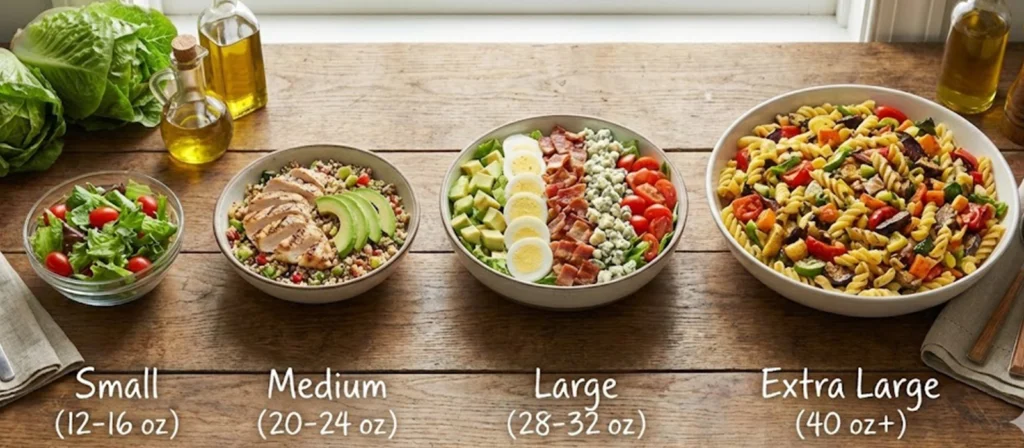
※Small salad bowls around 12 to 16 oz
This salad bowl size is commonly used for side salads, fruit portions, or add on items. It works well for simple greens with minimal toppings or as a companion to a main dish. Because of the limited space, this size is not ideal for mixed salads with grains, proteins, or heavy dressings. It is often chosen by cafes and quick service restaurants where salads are not the primary menu focus.
※Medium salad bowls around 20 to 24 oz
This is one of the most popular salad bowl size ranges for single serving meals. It provides enough room for leafy greens plus toppings like chicken, eggs, cheese, or roasted vegetables. Medium bowls strike a balance between portion satisfaction and cost control, which makes them a standard option for lunch salads and customizable menu items.
※Large salad bowls around 28 to 32 oz
A large salad bowl size is typically used for full meal salads with multiple components. These bowls allow space for proper mixing and layered presentation without compressing ingredients. They are common in salad focused brands, health food restaurants, and delivery orders where customers expect a filling portion that can replace a main course.
※Extra large salad bowls 40 oz and above
This salad bowl size is less common for individual orders and is more often used for sharing, catering, or family style portions. It can also appear in meal prep scenarios where multiple servings are packed together. While these bowls offer flexibility, they require careful consideration of lid strength, stacking stability, and storage space.
Salad Bowl Size Comparison Table
| Bowl Size oz | Volume Approx ml | Common Applications | Practical Handling and Lid Guidance |
|---|---|---|---|
| 12 oz | 355 ml | Side salads fresh fruit kids portions | Low profile lids or lightly tinted clear lids suit combo meals |
| 16 oz | 473 ml | Light lunch salads vegetable based bowls | Performs best with limited toppings to maintain visual balance |
| 24 oz | 710 ml | Standard single serve salads | Often viewed as the most balanced size for fast casual menus |
| 25 oz | 739 ml | Popular individual meal size | Frequently used across EU and UK with broad lid compatibility |
| 28 oz | 828 ml | Grain based salads premium ingredients | Provides extra space without moving to oversized bowls |
| 32 oz | 946 ml | Filling salads with protein and grains | Favored by many US chains for full meal portions |
| 36 oz | 1065 ml | Large poke bowls pasta or noodle salads | Lid height should be checked to avoid ingredient compression |
| 42 oz | 1242 ml | Shared bowls family style servings | Stronger lids improve stability during transport |
| 44 oz | 1301 ml | Deli counters and party trays | Anti slip features help reduce movement when stacked |
| 50 oz | 1479 ml | Catering events and group salads | Confirm carton weight limits and stacking efficiency |
What are the common salad bowl materials
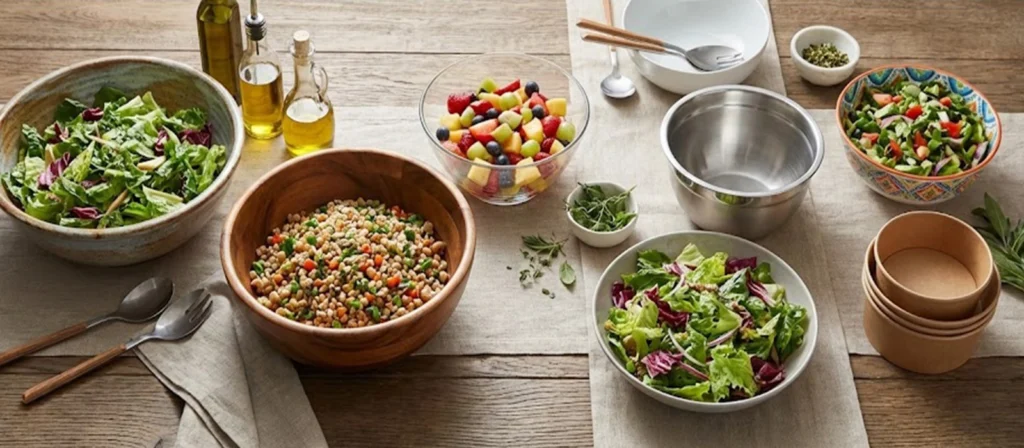
Choosing the right salad bowl size always goes hand in hand with material selection. Different materials affect how a bowl handles moisture, oil, temperature, and transport. Below are four of the most common salad bowl materials used in foodservice and takeaway packaging, each with distinct performance characteristics and use cases.
1. Kraft paperboard

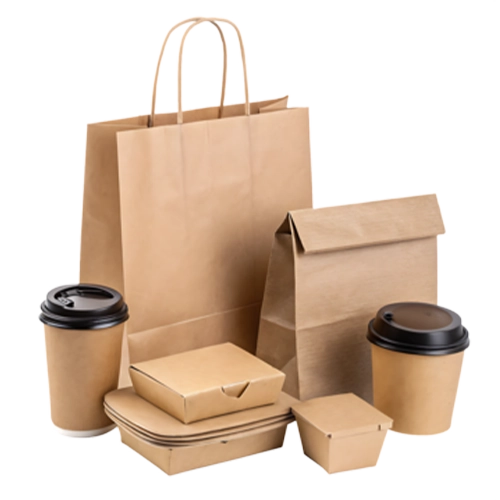
Kraft paperboard is a recyclable and durable material widely used for salad bowls. To improve performance, it is typically paired with a thin inner lining made from polyethylene or polylactic acid, which helps resist oil and moisture. They are commonly used for cold salads, fruit bowls, and light meals where structure and visual appeal are equally important. When paired with the right salad bowl size, kraft paperboard offers a good balance between rigidity, cost control, and sustainability perception.
2. Bagasse sugarcane fiber
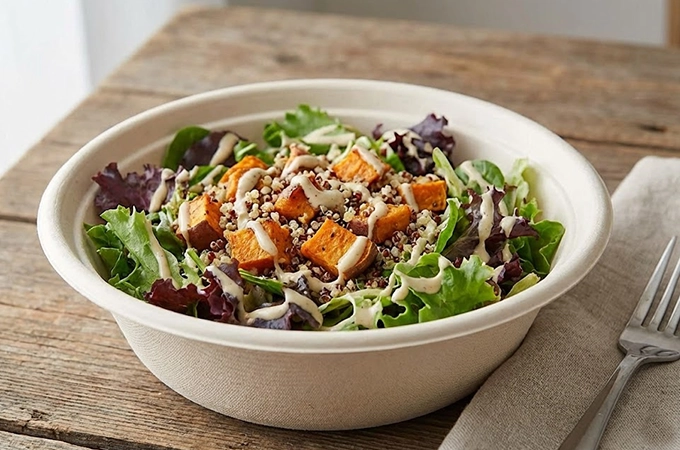
Bagasse, also known as sugarcane pulp, is made from agricultural byproducts and is fully compostable and biodegradable under appropriate conditions. This material is naturally strong, grease resistant, and capable of handling both hot and cold foods. Bagasse salad bowls are often chosen by foodservice operators that prioritize environmental responsibility without sacrificing durability. They perform well in medium to large salad bowl size formats, especially for salads that include warm grains, roasted vegetables, or sauces.
3. PET plastic
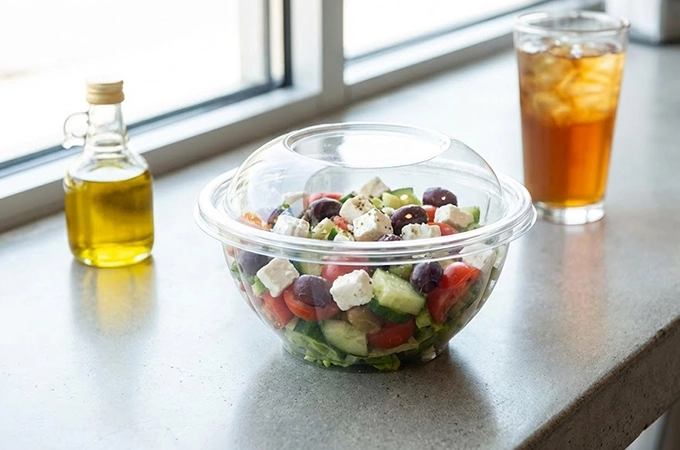
PET is a clear and recyclable plastic material frequently used for salad bowls and lids. Its main advantage is transparency, which allows customers to clearly see the freshness and color of the ingredients inside. PET is especially popular for cold salads, deli items, and grab and go displays where visibility directly influences purchase decisions. While PET is not suitable for hot foods, it works extremely well for showcasing salads when matched with an appropriate salad bowl size that highlights layered ingredients.
4. PLA bioplastic
PLA is a plant based compostable material made from renewable resources such as corn starch. It is commonly used for clear lids or as a coating for paper based salad bowls. PLA offers oil and moisture resistance similar to conventional plastics while supporting sustainability goals. However, it is best suited for cold or room temperature foods, as high heat can affect its structural stability. In salad packaging, PLA is often combined with paperboard bowls to create a balanced solution that supports both performance and environmental positioning.

The table below summarizes these common salad bowl materials and their key characteristics to make comparison easier.
| Material | Sustainability Profile | Heat Resistance | Transparency | Typical Salad Applications |
|---|---|---|---|---|
| Kraft paperboard | Recyclable often with PE or PLA lining | Cold to warm | Opaque | Cold salads fruit bowls light meals |
| Bagasse sugarcane fiber | Compostable and biodegradable | Hot and cold | Opaque | Hot and cold salads grain based bowls |
| PET plastic | Recyclable plastic | Cold only | Clear | Fresh salads deli and display items |
| PLA bioplastic | Compostable under industrial conditions | Cold to room temperature | Clear or coated | Salad lids coated paper bowls |
Understanding how these materials behave helps ensure that the selected salad bowl size performs well in real service conditions. Matching material properties with portion size, temperature, and presentation needs is essential for reliable and appealing salad packaging.
Capacity vs Real Fill
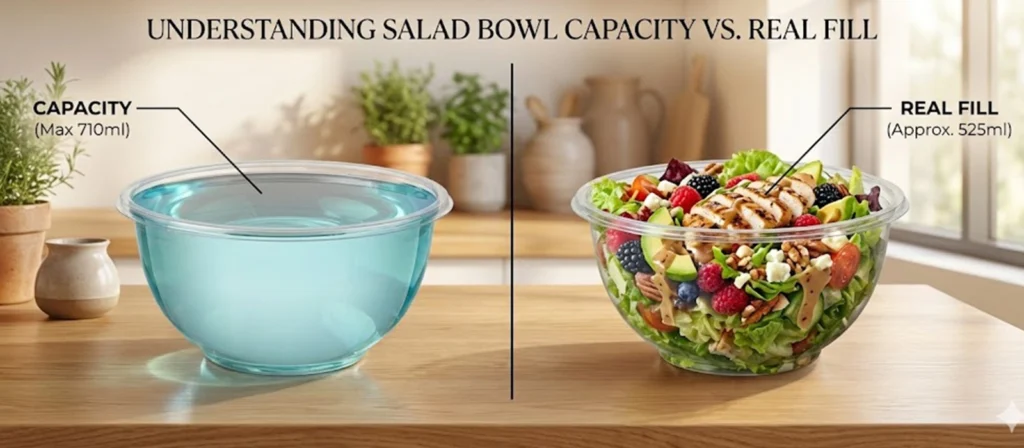
When choosing disposable bowls, it is important to understand that capacity and real fill are not the same thing. Capacity refers to the maximum volume a bowl can hold when filled to the brim, while real fill describes the practical amount of food that can be served comfortably without spilling. For salad bowls in particular, real fill is always lower than the stated capacity because space is needed for mixing, toppings, dressing and safe handling.
In real food service scenarios, salads are rarely filled to the edge. Leaves, proteins and toppings take up irregular space, and customers expect a bowl that looks full but not overcrowded. Understanding the difference between bowl capacity and real fill helps businesses select the right size, avoid under serving and reduce complaints related to portion perception.
Below is a reference table showing the typical relationship between salad bowl capacity and real fill volume. Values are approximate and based on common food service usage rather than laboratory measurements.
| Bowl Capacity | Approximate Capacity (ml) | Typical Real Fill Volume | Practical Use Scenario |
|---|---|---|---|
| 12 oz | about 355 ml | 250 to 280 ml | Side salads, fruit cups |
| 16 oz | about 473 ml | 330 to 380 ml | Small meal salads |
| 24 oz | about 710 ml | 500 to 550 ml | Standard entrée salads |
| 32 oz | about 946 ml | 650 to 720 ml | Large salads with toppings |
| 40 oz | about 1180 ml | 800 to 900 ml | Premium or sharing salads |
Using real fill volume rather than maximum capacity as a reference allows food businesses to match bowl size more accurately with menu portions, pricing and customer expectations.
Matching Salad Bowl Capacity with Lid Size
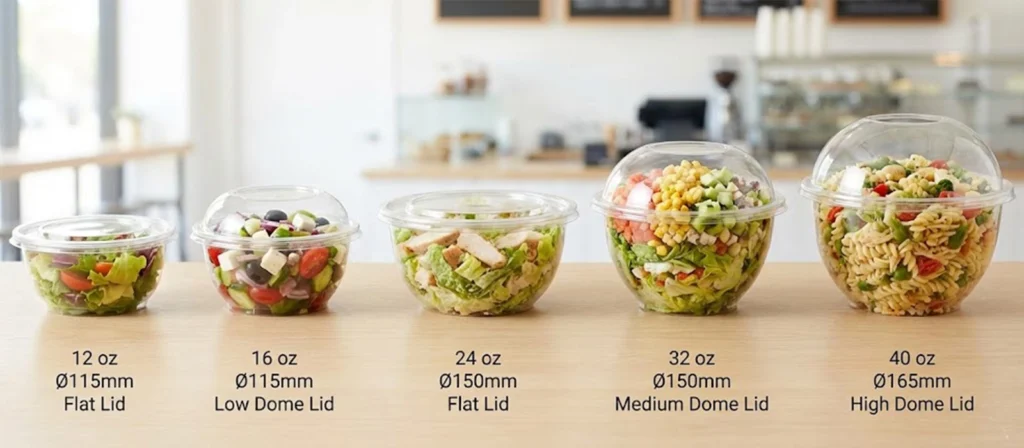
When selecting salad bowls, the bowl capacity alone is not enough to ensure proper packaging performance. Salad bowl lid size must match the bowl’s top diameter and rim design so the container can close securely without gaps or deformation. A mismatched lid may pop off during transport, leak dressing or make the bowl difficult to stack, even if the bowl capacity itself is correct.
In practice, salad bowls with different capacities often share similar lid diameters, especially within the same product series. However, deeper bowls usually require lids with stronger locking structures or higher domes to accommodate ingredients piled above the rim. Understanding how bowl capacity corresponds to lid size helps food businesses avoid fitting issues and simplifies procurement.
Below is a reference table showing typical salad bowl capacities and their commonly matched lid sizes. Actual specifications may vary slightly by manufacturer, but these pairings reflect widely used food service standards.
| Salad Bowl Capacity | Approximate Capacity (ml) | Common Lid Diameter | Typical Lid Type |
|---|---|---|---|
| 12 oz | about 355 ml | 115 mm | Flat clear lid |
| 16 oz | about 473 ml | 115 mm | Flat or low dome lid |
| 24 oz | about 710 ml | 150 mm | Flat clear lid |
| 32 oz | about 946 ml | 150 mm | Medium dome lid |
| 40 oz | about 1180 ml | 150 mm to 165 mm | High dome lid |
Choosing the correct lid size for each salad bowl capacity improves sealing reliability, protects food presentation and reduces issues during takeaway and delivery. When bowl and lid are designed to work together, packaging becomes easier to use for staff and more dependable for customers.
How do you choose the right salad bowl size
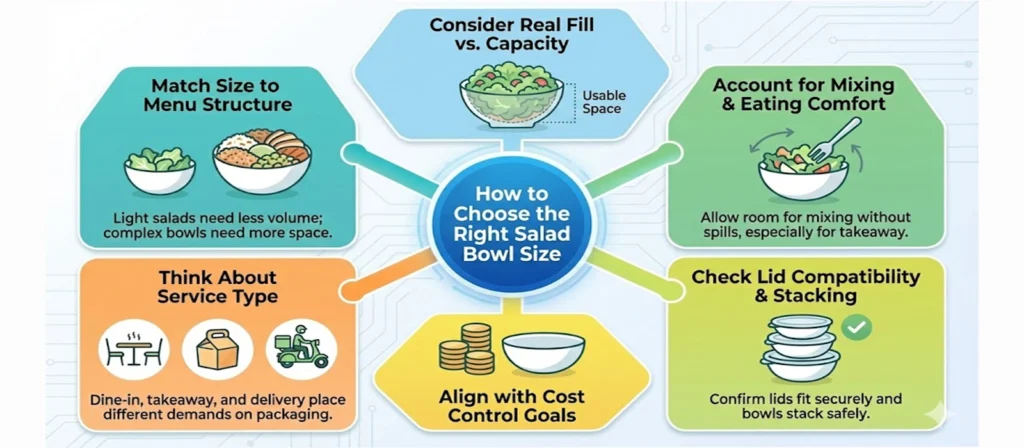
Choosing the right salad bowl size requires balancing portion needs, menu design, and real world usage. Instead of relying on a single factor, it helps to evaluate several practical considerations together.
- Match the bowl size to the menu structure Light green salads with few toppings need less volume, while grain bowls and protein heavy salads require more space. The salad bowl size should reflect how the dish is built, not just its listed portion weight.
- Consider real fill rather than labeled capacity Ingredients like leafy greens, pasta, and roasted vegetables all occupy space differently. A bowl may technically hold a certain volume, but usable space is often lower once mixing room and lid clearance are considered.
- Account for mixing and eating comfort Customers often toss salads before eating. A suitable salad bowl size should allow room for mixing without spills, especially for takeaway and delivery orders.
- Think about service type and handling Dine in, takeaway, and delivery place different demands on packaging. A bowl used for delivery needs extra headroom and a secure lid, which can influence the ideal salad bowl size.
- Align bowl size with cost control goals Larger bowls increase material, storage, and shipping costs. Selecting a salad bowl size that fits the actual portion helps maintain margins without compromising customer satisfaction.
- Check lid compatibility and stacking stability Not all lids fit every bowl size equally well. Confirm that the chosen salad bowl size works with available lids and stacks safely during transport and storage.
In practice, the best salad bowl size is one that supports how the food is prepared, served, and delivered while meeting customer expectations for portion and presentation.
What mistakes should you avoid when choosing salad bowl size
Choosing a salad bowl size based on assumptions rather than real use often leads to operational issues and customer dissatisfaction. Below are four common and avoidable mistakes that buyers and operators should watch for.
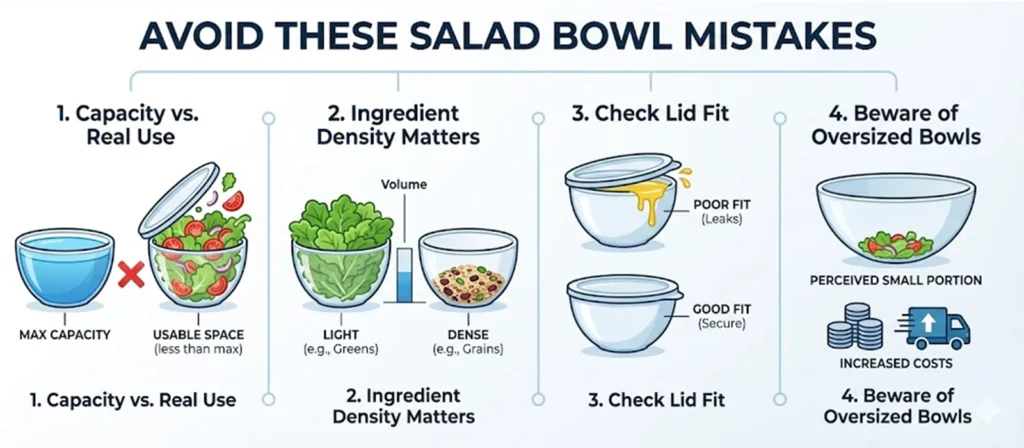
1. Relying only on labeled capacity
One of the most frequent mistakes is choosing a salad bowl size based solely on the printed volume. Labeled capacity reflects the maximum fill level, not the usable space needed for mixing, toppings, and lid clearance. Ignoring this difference can result in overfilled bowls, messy presentation, and compromised delivery performance.
2. Ignoring ingredient structure and density
Not all salads behave the same inside a bowl. Leafy greens, grains, proteins, and sauces each occupy space differently. Selecting a salad bowl size without considering ingredient density often leads to bowls that feel either cramped or visually empty once filled.
3. Overlooking lid fit and sealing performance
A bowl that seems adequate on its own may fail when paired with the wrong lid. Poor lid fit can cause leaks, crushed ingredients, or lids popping off during transport. Salad bowl size should always be evaluated together with lid compatibility and sealing strength.
4. Choosing oversized bowls for perceived value
Using a larger salad bowl size to create a premium impression can backfire. Oversized bowls increase material and logistics costs and may make portions appear smaller than intended. Customers tend to respond better to bowls that look properly filled rather than simply larger.
Avoiding these mistakes helps ensure that the chosen salad bowl size supports food quality, operational efficiency, and customer satisfaction at the same time.
How to avoid these mistakes
- Test bowls with real menu items
Fill sample bowls using actual ingredients and dressing to observe real fill, mixing space, and lid clearance. - Evaluate bowl and lid as a set
Always check sealing strength, lid height, and stacking stability together with the selected salad bowl size. - Align size with portion standards
Base the salad bowl size on consistent portion targets rather than visual assumptions or marketing preference. - Review costs beyond the bowl itself
Consider storage space, carton weight, and transport efficiency when finalizing a salad bowl size.
Using these steps helps ensure the chosen salad bowl size performs well in daily operations while meeting presentation and cost goals.
Conclusion
Choosing the right salad bowl size is a practical decision that affects food presentation, portion control, cost management, and customer satisfaction. From understanding real fill versus labeled capacity to matching bowl size with ingredients, materials, and service style, each detail plays a role in how a salad performs from preparation to consumption. A well chosen salad bowl size supports clean presentation, easier handling, and a more consistent dining experience across dine in, takeaway, and delivery.
Rather than treating bowl size as a simple volume number, successful foodservice operators view it as part of a complete system that includes materials, lids, logistics, and menu design. By avoiding common mistakes and using size guidelines thoughtfully, businesses can select a salad bowl size that aligns with their brand, meets operational needs, and delivers real value to customers.