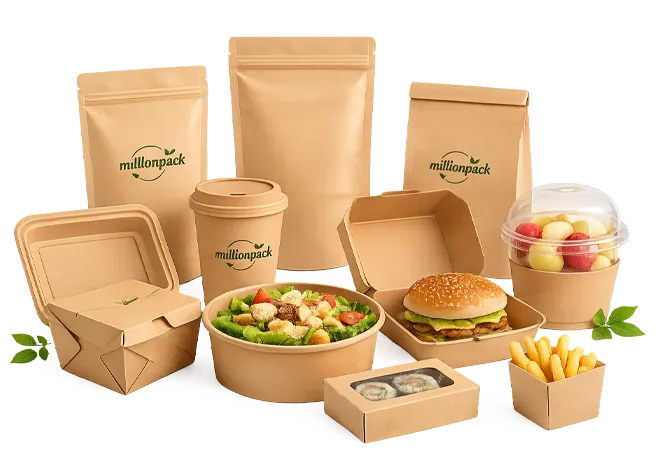
BPI Compostable refers to products that have been tested and certified by the Biodegradable Products Institute to meet established compostability standards. This certification confirms that the material can break down in an industrial composting environment and return to the soil without leaving harmful residues.
The BPI Compostable label is widely used on disposable food packaging, including paper bowls, cups, plates, and takeout containers. For food service operators and packaging buyers, this mark provides a reliable way to identify products designed to meet recognized composting requirements.
Still, BPI Compostable does not automatically mean suitable for home composting or landfill disposal. Understanding the scope and limits of this certification is key to using it correctly in real world applications.
What are BPI Certified Compostable Products?
1. What is BPI?
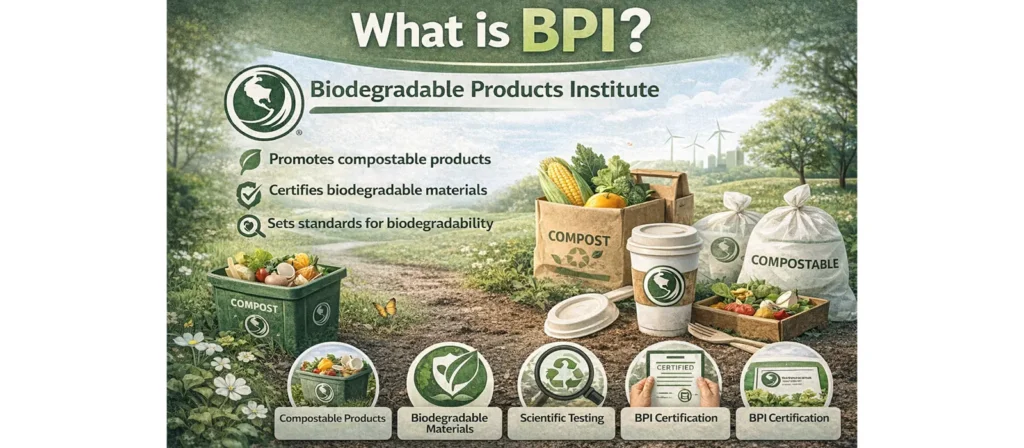
BPI stands for Biodegradable Products Institute, a North American non-profit that focuses on one thing: verifying whether products and packaging actually meet scientifically defined compostability standards. It runs a third-party certification program that uses standardized laboratory tests to decide whether an item can carry the BPI Certification Mark.
In other words, when a product says BPI compostable, it is not just the manufacturer talking about itself. It is a claim that has been checked independently against clear technical criteria.
2. What Does “Bpi Compostable” Really Mean?
A BPI certified compostable product is one that:
- Has been tested using internationally recognized compostability standards such as ASTM D6400 (for plastics) and ASTM D6868 (for plastic coatings on paper and board).
- Breaks down under controlled composting conditions within a defined time frame (generally within a few months) so that it is no longer distinguishable as a piece of packaging.
- Does not leave behind toxic residues or concentrations of heavy metals that would make the resulting compost unsafe for soil or plants.
BPI certified compostable products are designed to go into industrial or municipal composting facilities, alongside food scraps and yard waste. They are not designed for traditional recycling streams, and they are not primarily aimed at landfill disposal.
3. How Are They Different From “Biodegradable” or “Eco” Products?
A lot of food packaging today uses language like “biodegradable,” “degradable,” “plant-based,” or “eco-friendly.” These terms sound positive, but they are vague and often unregulated.
The key differences are:
- Biodegradable only says that a material can be broken down by organisms at some point; it usually does not say how fast this happens, in what environment, or what is left behind.
- Compostable in the BPI sense means the product has passed specific tests for disintegration, biodegradation, and safety in a composting environment.
- BPI compostable means a credible third party has checked the compostable claim against ASTM standards and confirmed that the product behaves as required in industrial composting.
4. Typical Examples of Bpi Certified Compostable Products
In the food and food-service world, you will most often see BPI compostable on:
- Hot and cold drink cups with a compostable lining
- Take-out clamshells, trays, and bowls
- Cutlery (forks, spoons, knives) made from compostable bioplastics
- Food-scrap collection bags and bin liners
- Flexible pouches or films designed for food items, when they meet the relevant standards.

What are the ASTM D6400 or D6868 Standards?
ASTM D6400 and ASTM D6868 are the two primary standards used in the United States to determine whether a material is truly compostable in an industrial facility. These standards are established by ASTM International, a globally recognized organization that sets technical benchmarks across industries.
ASTM D6400 applies to plastics and products made entirely from compostable polymers. It ensures that the product disintegrates, biodegrades into natural substances, and leaves no toxic residue.
ASTM D6868 applies to items made from paper or fiber-based materials that are coated with compostable plastics. This includes things like paper cups or food trays with a thin plastic lining.
What Conditions Must BPI-Certified Compostable Packaging Meet?
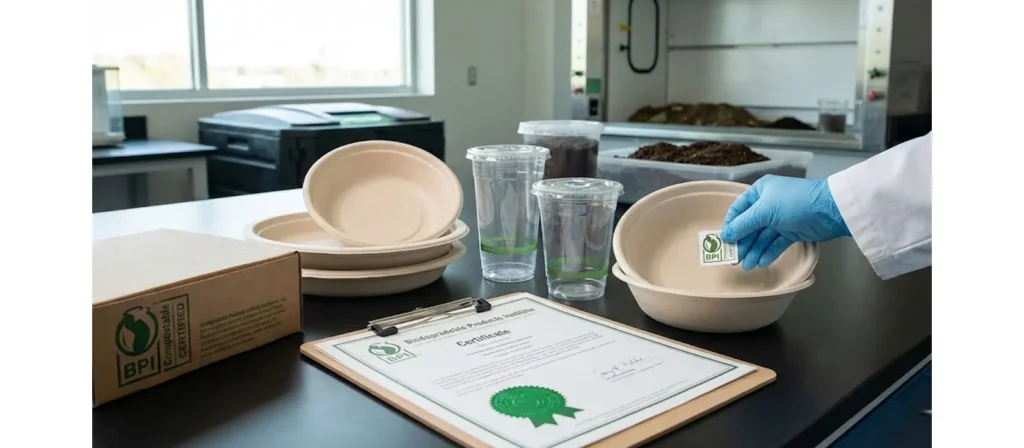
For a product to be certified by BPI, it must meet detailed criteria outlined in standards such as ASTM D6400 (for plastics) or ASTM D6868 (for coated paper products). These standards define what it means for a product to be compostable in an industrial setting — not just eventually breaking down, but doing so quickly, safely, and completely.
Here are the main conditions that BPI-certified compostable packaging must fulfill:
1. Disintegration Within a Specific Timeframe
The product must physically break apart and become indistinguishable in a compost environment within 90 days. This ensures the material doesn’t persist or cause operational issues at composting facilities.
2. Biodegradation into Natural Elements
At least 90% of the material must convert into carbon dioxide (CO₂), water, and biomass within 180 days. This mimics the natural composting process of organic matter like food scraps or yard waste.
3. No Toxicity to Soil or Plants
The finished compost, after the material has degraded, must be safe for plant growth. That means no heavy metals, no hazardous residues, and no ecotoxic effects. Products are tested using plant toxicity tests to confirm safety.
4. No Visible or Harmful Microplastics Left Behind
The material must completely disappear without leaving plastic fragments. This is a critical condition distinguishing compostable materials from those that merely fragment without fully degrading.
5. Proper Labeling and Identification
The packaging must be clearly labeled so composting facilities and consumers can identify the item as compostable and sort it properly. Misidentification can cause contamination in composting streams.
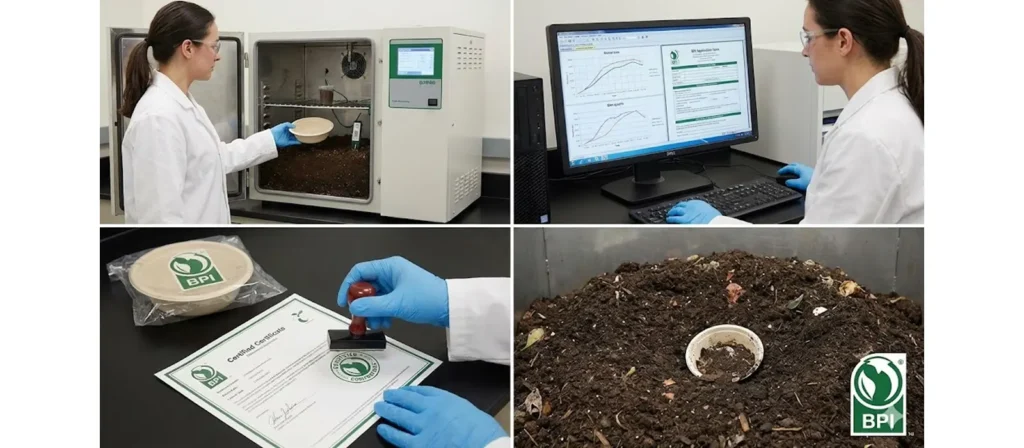
BPI Certification Process
The certification process overseen by BPI is detailed and science-driven. It’s designed to eliminate greenwashing and ensure that only truly compostable products receive the label. Here’s how the process works:
1. Application and Documentation
The process starts when a company applies BPI. That application generally includes:
- A detailed formulation of the material or product (what it is made of).
- Safety data sheets from each supplier for every ingredient.
- Information about the intended use, such as whether it is food-contact packaging or a bin liner.
- Photos or samples of the product.
Once everything is received, BPI assigns a project manager who becomes the main point of contact for the applicant and coordinates the next steps.
2. Testing at Approved Laboratories
BPI itself does not run the decomposition tests. Instead, it relies on independent laboratories that are experienced in conducting ASTM compostability tests.
In the lab, the product (or the base material) is subjected to:
- Disintegration tests in controlled composting conditions, where it is mixed into compost and monitored to see how thoroughly and how quickly it breaks apart.
- Biodegradation tests, which track how much of the carbon in the material is converted to carbon dioxide over time.
- Ecotoxicity tests, often involving plant growth trials in compost containing the material.
- Chemical analysis, including tests for heavy metals and sometimes other regulated substances.
3. Review of Test Results
BPI’s technical team reviews the laboratory data to determine whether the product meets compostability requirements. The review also checks for full transparency about ingredients and potential contaminants.
4. Certification Approval and Licensing
If the product passes all criteria, it is approved and added to BPI’s public database. The manufacturer receives a license to use the BPI Certification Mark on packaging and marketing materials. The logo must be used in compliance with BPI’s labeling guidelines to avoid misuse or confusion.
5. Ongoing Compliance and Re-Certification
Certification is not a one-time event. If a manufacturer changes materials, suppliers, coatings, or manufacturing processes in a way that could affect compostability, they are expected to inform BPI and may need to submit new data or retest.
Additionally, certification is typically granted for a set period (for example, three years), after which it must be renewed. Periodic re-certification helps ensure that products still match their original tested formulation and performance.

Why is Bpi Compostable Certification Important for Food Packaging?
Food packaging is one of the biggest growth areas for compostable products. At the same time, it is an area where vague environmental claims can easily mislead both businesses and consumers. BPI compostable certification plays several important roles here.
1. Ensures Functional and Environmental Performance
Food packaging must be durable during use and degradable after disposal. BPI certification verifies that the item can fulfill its purpose while also composting efficiently, avoiding plastic pollution and landfill buildup.
2. Reduces Confusion in Waste Sorting
Without proper labeling, compostable and non-compostable packaging can look virtually identical. BPI certification gives composting facilities and consumers a clear, reliable signal — which improves sorting and reduces contamination.
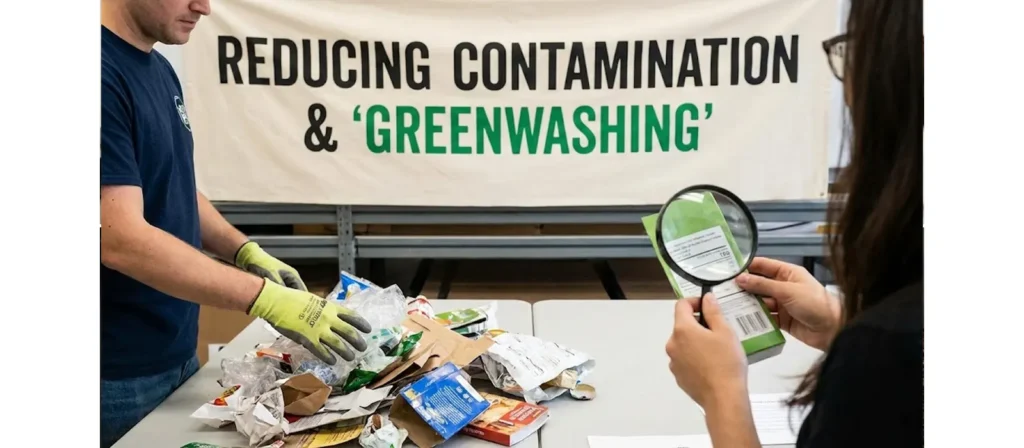
3. Reducing Contamination and “Greenwashing”
From the point of view of a compost facility, contamination is a constant concern. When non-compostable plastic ends up in food waste, it can damage equipment, reduce compost quality, and force expensive extra screening steps.
BPI certification helps by:
- Distinguishing tested, compostable packaging from look-alike products that are just labeled “biodegradable” or “eco.
- Providing a single, recognizable logo that haulers, facility operators, and staff can be trained to look for.
For brands, using BPI compostable packaging is also a way to avoid accusations of greenwashing. Instead of making their own unverifiable claims, they can point to an established third-party standard.
4. Building Trust With Consumers and Business Customers
Consumers are increasingly aware that not all “green” labels are equal. BPI compostable gives them a clearer signal that:
- The packaging has been checked against objective compostability criteria.
- If they have access to the right kind of collection service, the item can be part of a real circular system instead of ending up as contamination or landfill.
For business customers (such as restaurant chains, caterers, or food brands supplying supermarkets), BPI certification can be a requirement in purchasing specifications. It provides a concrete way to enforce sustainability standards across large packaging portfolios.
5. Supporting Regulatory and Corporate Sustainability Goals
As cities, states, and countries introduce organics diversion targets, bans on certain single-use plastics, or Extended Producer Responsibility (EPR) rules, food brands are under pressure to show how their packaging strategy fits into these changes.

How to Identify BPI-Certified Compostable Products?
Recognizing whether a product is genuinely BPI-certified is essential for both consumers and compost facility operators. Misidentifying packaging as compostable when it is not can lead to contamination, operational issues, and a breakdown in consumer trust.
Here’s how to correctly identify a BPI-certified compostable product:
1. Look for the BPI Certification Logo
The most reliable indicator is the official BPI Certification Mark. This logo is only allowed on products that have passed all testing and certification requirements. It’s usually found on the product itself, its packaging, or both.
2. Check for ASTM Standards
The product label should reference compliance with ASTM D6400 or D6868. This confirms that the product has been tested for industrial compostability.
3. Verify the Certification Online
BPI maintains a public directory where you can search by product name, company, or category. If a product claims to be certified but is not listed in the directory, the claim is likely unverified or misleading.
4. Examine the Disposal Instructions
Certified products should have clear instructions indicating they are compostable in commercial or municipal facilities — not in backyard compost systems unless specifically tested for home composting.
5. Pay Attention to Color Cues and Design
Some state rules go further and require compostable products, especially bags and films, to use specific colors or stripes to distinguish them from regular plastics. For example, guidance may require:
- Green, beige, or brown tinting,
- Or a contrasting green or beige stripe along the bag or film,
- Plus the word “compostable” clearly visible.
BPI’s own labeling recommendations align with this type of approach and aim to make certified packaging visually distinct so composters can quickly tell it apart from non-compostable items.
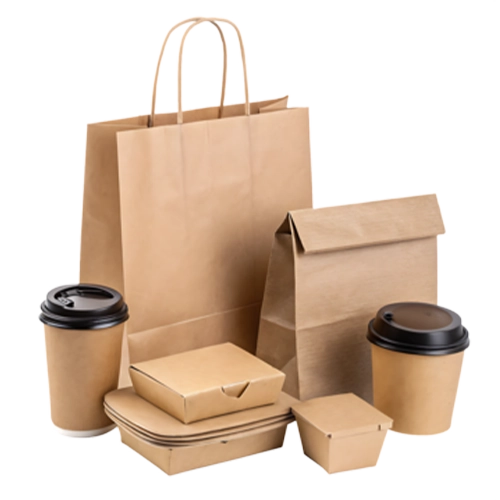
Material Selection and Industry Applications
Below is a simplified overview of common compostable materials and where they are most often applied across industries. This can guide both procurement professionals and sustainability managers in choosing appropriate BPI-compliant alternatives.
| Material Type | Typical Use Case | Industry Application |
|---|---|---|
| PLA (Polylactic Acid) | Cups, lids, clamshells, films | Foodservice, Grocery, Retail Packaging |
| PHA (Polyhydroxyalkanoates) | Cutlery, straws, film coatings | Quick-Service Restaurants, Consumer Goods |
| Compostable Paperboard | Takeout boxes, ice cream cartons | Food Packaging, Frozen Goods |
| Compostable Bag Films | Compost liners, produce bags | Waste Collection, Grocery Retail |
| Cellulose-Based Films | Wrappers, transparent windows on boxes | Snack Packaging, Specialty Retail |
| Starch Blends | Trash bags, pet waste bags | Residential, Commercial Waste Programs |
| Molded Fiber with Coating | Trays, plates, bowls | Institutional Dining, Airline Catering |
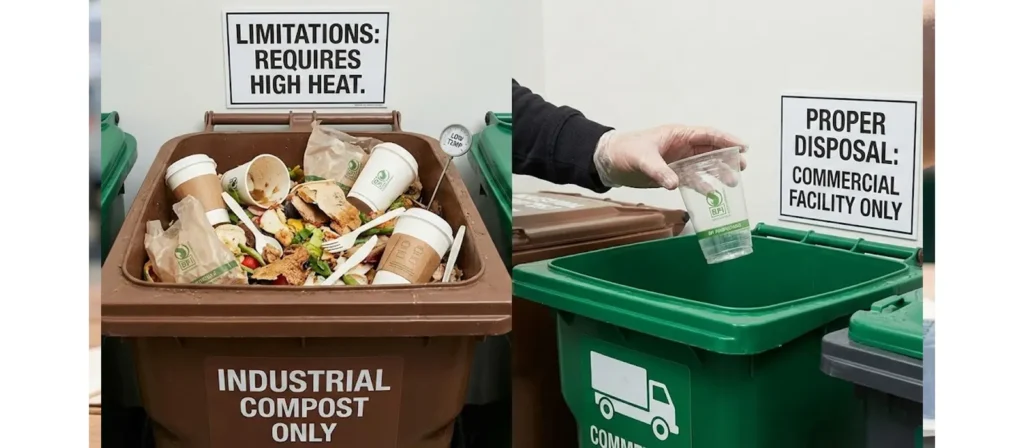
Limitations of BPI Compostable Products and Proper Disposal Methods
While BPI-certified compostable products represent an important step forward in sustainable materials management, they are not without limitations. Understanding these constraints is essential to using these products effectively and responsibly.
1. Requires Industrial Composting Conditions
Most BPI-certified items are designed specifically for industrial composting facilities, which operate at higher temperatures and controlled oxygen levels. These conditions are not present in backyard compost systems, where certified products may persist for months or fail to break down at all.
2. Limited Access to Facilities
Not all communities have access to industrial composting infrastructure. This creates a situation where even certified products may still end up in landfills if no proper disposal route exists. Landfills lack the oxygen and microbial activity necessary for composting, so these products won’t break down as intended.
3. Misuse and Mislabeling by Consumers
Consumers often confuse compostable with recyclable or biodegradable, leading to improper disposal. Compostable items placed in recycling streams can contaminate entire batches of recyclables. Similarly, items labeled “biodegradable” without certification often don’t meet composting standards and can mislead well-intentioned consumers.
4. No Degradation in Nature or Water
Certified compostable plastics are not designed to degrade in marine environments, soils, or open landscapes. If littered, they behave similarly to conventional plastics. BPI certification only ensures breakdown under controlled composting conditions.
Proper Disposal Guidelines:
- Always check local composting guidelines to see if compostable packaging is accepted.
- If industrial composting is available, place BPI-certified items in designated compost bins.
- Never put compostable items in the recycling bin unless explicitly directed.
- If composting isn’t available, it’s better to place these items in the trash than to risk contaminating the recycling stream.
Can BPI-Certified Compostable Containers Be Recycled?
BPI-certified compostable containers should not be recycled. These items are made from materials that differ fundamentally from conventional plastics and paper products used in recycling systems.
Compostable plastics such as PLA have different melting points and chemical properties, which can contaminate recycling streams and disrupt processing equipment. Similarly, coated paper items that are designed to compost are engineered to break down in moist, hot environments — conditions they would not encounter in recycling centers.
The safest practice is to always separate compostable products from recyclables. When in doubt, consult your local waste management provider to understand the proper disposal stream for compostable packaging in your area.

Where Can BPI-Certified Compostable Food Packaging Be Composted?
BPI-certified compostable food packaging is intended for disposal in commercial or municipal composting facilities that are equipped to handle organic waste at scale. These facilities use controlled temperatures, moisture levels, and microbial activity to rapidly decompose certified materials.
To find a facility near you, consider the following:
1. Municipal Organics Programs
Many cities now offer curbside compost collection for residents and businesses. Check with your local sanitation or waste management authority to confirm if compostable packaging is accepted in the organics bin.
2. Commercial Composting Services
Businesses, schools, and institutions can often contract with specialized composting services that collect compostable waste, including BPI-certified packaging. These services are expanding rapidly in urban areas.
3. Public Drop-Off Locations
In regions without curbside collection, some composting programs offer drop-off sites for organics and compostable packaging. These may be located at farmers markets, waste transfer stations, or community gardens.
4. What About Home Composting?
Commercial composting differs from typical home composting. Home composting systems are usually smaller in scale, operate at lower temperatures, and have less consistent humidity and ventilation. Therefore, many industrially compostable products may decompose more slowly, or not at all, in a home composting environment.
FAQs
- Can BPI compostable products be composted at home?
Most are designed for industrial composting; check the label for instructions. - Is BPI certification required by law?
Not legally mandatory, but it ensures verified performance based on accepted standards. - Does BPI certification guarantee zero environmental impact?
Certification ensures compostability under defined conditions, but overall impact depends on systems and behavior. - Can I recycle BPI compostable food containers with regular plastics?
Generally no. Compostable plastics are chemically different from common recyclable plastics and can contaminate recycling streams. They should go to an industrial composting facility if one is available in your area. - What is the difference between compostable and biodegradable?
Compostable means it meets specific standards for breaking down safely in composting systems; biodegradable is a vague term that does not specify time, conditions, or residue. - Are BPI compostable products always the most sustainable choice?
Not always. They work best where strong composting infrastructure exists; in some cases, reusables or easily recycled materials can have a lower overall impact.
In Summary
BPI-certified compostable products represent a credible, science-based solution to the growing demand for sustainable materials — particularly in food packaging. Unlike vague or unregulated claims like “biodegradable,” the BPI certification is grounded in rigorous testing against internationally recognized standards, such as ASTM D6400 and D6868.
These standards ensure that certified items disintegrate, biodegrade, and leave no harmful residues when processed in industrial composting environments.
Ultimately, while compostable materials are not a silver bullet for the global waste crisis, BPI certification offers a trustworthy path forward for reducing plastic pollution and closing the loop on packaging waste, provided they are disposed of responsibly and supported by the right systems.