
In recent years, the European Union has strengthened its environmental policies to address global deforestation and climate change. One of the most significant steps in this direction is the European Union Deforestation Regulation (EUDR), which aims to ensure that products entering the EU market are not linked to deforestation or forest degradation. This regulation reflects the EU’s commitment to sustainability and responsible trade.
Businesses, suppliers, and retailers are now under pressure to examine their sourcing practices and verify that their products meet EUDR standards. Without a clear understanding of which goods are affected, companies risk delays at EU borders, increased due diligence costs, and possible exclusion from one of the world’s largest markets.
This article focuses on answering that critical question. We will break down the product categories explicitly mentioned in the EUDR, explain why they were included, and highlight what this means for global suppliers and manufacturers seeking access to the European market.
What Products Are Affected by EUDR?
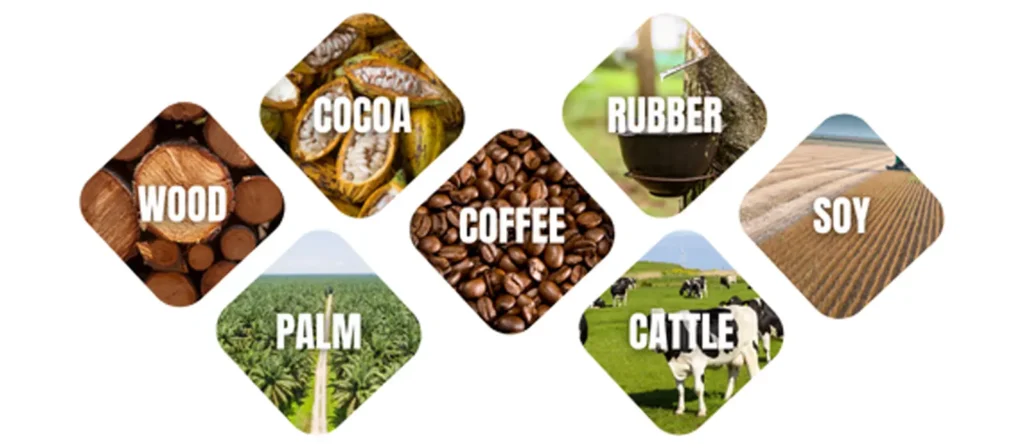
EUDR specifies certain “relevant commodities” (i.e. primary goods) that it directly regulates. It also brings into scope processed products that incorporate these commodities or derived materials. Understanding both levels is key.
Core “Relevant Commodities”
The main raw / primary commodity types regulated under EUDR are:
- Cattle / Livestock
- Cocoa
- Coffee
- Palm Oil / Oil Palm / Palm Kernels / Palm Products
- Natural Rubber
- Soy / Soya
- Wood / Timber
If a commodity in these categories is implicated in forest conversion or degradation in its supply chain, it could be noncompliant under EUDR.
Derived Products, Processed Products & Inclusion Scope
EUDR does not only regulate raw commodities. It also covers derived, processed, or manufactured products that incorporate these commodities (or their derivatives). If a final product includes a regulated commodity as an ingredient, that product may fall under EUDR oversight.
Regulators refer to Annex I of the regulation (and relevant tariff / HS / CN codes) to determine which specific processed goods are covered.
Derived Products and Downstream Items in Scope
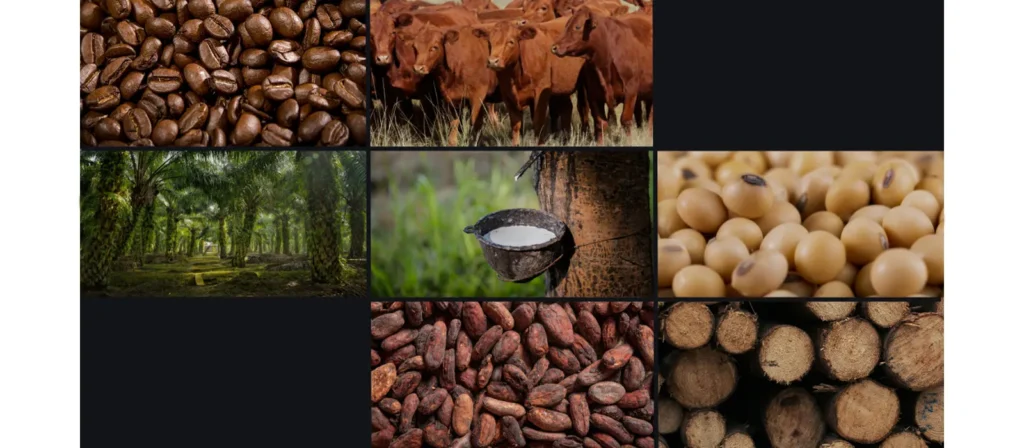
Below we examine, for each regulated commodity category, the typical downstream product forms, and discuss possible exemptions or borderline cases.
1. Cattle / Livestock / Beef / Leather
This category is one of the most visible under EUDR, because livestock expansion is often linked to deforestation.
Affected product forms include:
- Live cattle trade
- Beef (fresh / chilled / frozen)
- Edible offal (organs, innards)
- Raw hides and skins
- Leather and semi-processed leather
- Finished leather goods (bags, shoes, belts, accessories)
- Food products containing beef or beef‑derived ingredients
Possible exemptions / edge cases:
- If beef is only a minor accessory ingredient in a food product, it may not count as a regulated commodity
- Non‑food uses, waste hides, or recycled leather from fully post‑consumer waste streams may be excluded, depending on regulations
In practice, a leather handbag using bovine leather plus synthetic materials might bring the product into EUDR’s ambit via the leather component.
2. Cocoa & Chocolate Products
Affected forms include:
- Raw cocoa beans
- Cocoa paste / mass
- Cocoa butter / cocoa fat
- Cocoa powder
- Chocolate and chocolate‐based confectionery
- Cocoa‐based beverages, candy, or products where cocoa is a principal ingredient
Possible exemptions / edge cases:
- Products with a trivial cocoa proportion may not be covered
- Highly refined cocoa extracts or derivatives whose original traceability is severed may fall outside the scope
Because many chocolate and confectionery products use cocoa as a central ingredient, this is a heavily impacted supply chain.
3. Coffee
Affected forms include:
- Green / raw coffee beans
- Roasted coffee
- Ground coffee / instant coffee (if the coffee component is traceable)
- Coffee beverages or products where coffee is a core ingredient
Possible exemptions / edge cases:
- Highly processed coffee extracts, flavorings, or derivatives that cannot be traced back to original beans may escape full regulation
- Products using minimal coffee as a flavor or additive may also lie outside strict regulatory reach
If a downstream product includes traceable coffee, it may need to comply with EUDR.
4. Palm Oil & Palm Derivatives
Palm oil and its derivatives are among the most broadly used commodities and thus among the most consequential under EUDR.
Affected forms include:
- Palm fruit / kernels / kernel oil
- Crude palm oil / refined palm oil
- Palm oil press cakes / residue
- Glycerol / glycerin derived from palm oil
- Fatty acids (lauric, palmitic, stearic, etc.) derived from palm oil
- Products in food, cosmetics, detergents, soaps, industrial uses that contain palm oil or derivatives
Possible exemptions / edge cases:
- Very highly refined or fractionated derivatives that sever traceability
- Use of 100% recycled (waste) oil in cosmetics or detergents, if appropriately documented
- Cases where palm oil is a minor or non‑core component
Because palm oil is used so widely (food, cosmetics, household products, industrial uses), it has a diffuse but significant downstream impact.
5. Natural Rubber
Natural rubber is less frequently discussed publicly, but its inclusion under EUDR carries broad implications.
Affected forms include:
- Raw natural rubber
- Semi-processed or unvulcanized rubber
- Vulcanized rubber products containing natural rubber
- Mixed rubber goods (tires, hoses, seals, gaskets, belts, footwear soles, rubber components)
- Products across automotive, industrial, consumer goods sectors that include natural rubber
Possible exemptions / edge cases:
- Products made predominantly of synthetic rubber; the natural rubber portion, if small or inseparable, may be treated minimally
- If natural rubber is completely recycled or from reclaimed sources (depending on regulatory definitions)
Because rubber’s supply chain is long and complex, tracing the origin of natural rubber content is a major compliance challenge.
6. Soy
Soy is deeply integrated into food, livestock feed, and industrial uses.
Affected forms include:
- Soybeans (raw soy)
- Soybean oil
- Soybean meal / cake / residues
- Food or feed products containing soy or soy derivatives
Possible exemptions / edge cases:
- Foods using soy in small or auxiliary amounts may be exempt
- Highly processed soy derivatives (e.g. soy protein isolates, extracts) whose traceability is broken may fall outside stringent rules
Also, soy used as animal feed upstream links indirectly to cattle / livestock supply chains.
7. Wood
Wood and wood derivatives are already regulated under previous EU rules, and EUDR intensifies that oversight.
Affected forms include:
- Raw timber / logs / debarked wood
- Processed wood (planks, boards, timber, beams)
- Composite wood materials (plywood, particleboard, MDF, etc.)
- Wood pulp / paper pulp
- Paper / cardboard / printed materials / books / newspapers
- Wooden furniture / wood building elements / doors, floors, panels
- Wood packaging, crates, pallets
Possible exemptions / edge cases:
- Transition period: wood placed on the market prior to June 29, 2023 is handled under earlier rules until end of 2027
- Fully recycled wood / reclaimed material may be exempt if properly documented
- Some composite or mixed materials may have partial exclusions depending on origin and documentation
Wood and furniture supply chains are heavily impacted due to their wide usage in construction, consumer goods, and packaging.

Key HS / CN Codes in EUDR Annex I (Selected examples)
Below are representative codes from Annex I of EUDR for the major commodities. This is not exhaustive but gives you the major ones you’ll frequently encounter.
Cattle / Livestock / Leather & Meat
- ex 0102 — Live cattle
- ex 0201 — Meat of cattle, fresh or chilled
- ex 0202 — Meat of cattle, frozen
- ex 0206 10 — Edible offal of cattle, fresh or chilled
- ex 0206 22 — Edible cattle livers, frozen
- ex 0206 29 — Edible cattle offal (excluding tongues & livers), frozen
- ex 1602 50 — Other prepared / preserved meat, offal, blood of cattle
- ex 4101 — Raw hides & skins of cattle (not tanned)
- ex 4104 — Tanned / crust hides / skins, without hair
- ex 4107 — Leather of cattle, further prepared (beyond tanning)
Cocoa
- 1801 00 00 — Cocoa beans, raw or roasted
- 1802 00 00 — Cocoa shells / husks / waste
- 1803 — Cocoa paste (whether or not defatted)
- 1804 00 00 — Cocoa butter / fat / oil
- 1805 00 00 — Cocoa powder (without added sugar)
- 1806 — Chocolate and other food preparations containing cocoa
Coffee
- 0901 — Coffee, whether or not roasted or decaffeinated; coffee husks / skins; coffee substitutes
Palm Oil & Soy (and derivatives)
- Palm oil and its derivatives have codes typically in chapters 15 and 38 etc., but they must be explicitly listed in Annex I to be regulated.
- Soy / soya beans often use codes like 1201 for raw soybeans, and derivatives under 1507 etc. (if listed)
Rubber
Some of the rubber codes under Annex I include:
- 4001 — Natural rubber, raw
- ex 4005 — Compounded but unvulcanized rubber
- ex 4006 — Unvulcanised rubber in other forms
- ex 4007 — Vulcanised rubber thread / cord
- ex 4008 — Vulcanised rubber sheets, plates, strips, etc.
- ex 4010 — Conveyor / transmission belts of vulcanised rubber
- ex 4011 — New pneumatic tyres
- ex 4012 — Retreaded / used tyres
- ex 4013 — Inner tubes
- ex 4015 — Rubber apparel & accessories
- ex 4016 — Other vulcanised rubber articles
- ex 4017 — Hard rubber in all forms
Wood / Timber / Paper / Furniture
- 44xx series for wood and wood products (e.g. 4401, 4403, 4407, etc.)
- 44xx / 48xx / 49xx for pulp, paper, printed matter
- 94xx for furniture / wood seats etc., parts thereof
- Examples from Annex I:
• 4420 — Wood marquetry, inlaid wood, wooden caskets, ornaments, etc.
• 4421 — Other articles of wood
• Printed books, newspapers, pictures, manuscripts (ex 49)
• 9401 — Wooden seats (excluding non-wood materials)
• 9403 30 / 9403 40 / 9403 50 / 9403 60 / 9403 91 — Wooden furniture & parts
• 9406 10 — Prefabricated buildings of wood

Risk Points in the Supply Chain for “Products Affected by EUDR”
Knowing which products are regulated is just one step. Identifying where in the supply chain risks may materialize is even more vital. Below is a breakdown of risk points:
| Stage / Segment | Key Risk Points | Explanation |
|---|---|---|
| Raw procurement / farm level | Land history / legality unknown | Farmers may lack records on land use history, rights, or legal permits |
| Fragmented smallholders / poor data integration | Small-scale producers are dispersed with limited record-keeping | |
| Crop mixing / co-mingling | Multiple crops or batches may be mixed in transportation | |
| Processing / intermediaries | Disruption of traceability | Processors may source from multiple upstream suppliers |
| Batch mixing / blending | Multiple raw material lots may be blended, obscuring origin | |
| High cost of compliance | Due diligence, geolocation collection, monitoring systems impose costs | |
| Export / trade / logistics | HS classification disputes | Customs may contest whether a product is in an EUDR-covered category |
| Export approval / extra documentation | Authorities may require extra proofs or checks | |
| EU market entry | Missing / incomplete documentation | Without a proper due diligence statement, the product cannot enter |
| Customs inspection / refusal | EU states may reject goods in spot checks if noncompliance is found |
Conclusion
Understanding which products are affected, where responsibilities lie, how to conduct traceability and due diligence, how to mitigate risks, and how to deploy technology and restructure supply chains will be key challenges for companies in the coming years. The emergence of EUDR fundamentally aims to promote environmental protection through trade rules and set “red lines” for global forest conservation. For companies involved in regulated product categories, analyzing their product portfolios, supply chain structures, traceability systems, and compliance capabilities now is crucial to avoiding future market exclusion or legal consequences.