
Choosing coffee cup sizes sounds simple until you have to order in bulk, match lids across suppliers, and align cup capacity with menu pricing. For importers, wholesalers, and café owners, cup size affects storage efficiency, shipping cost, portion control, and daily workflow.
Problems often surface only after expansion. A 12 oz cup from one supplier may not align with another supplier’s lid system, and a mug labeled 12 oz may quietly increase ingredient costs if it is consistently filled beyond the intended portion. These inconsistencies are rarely obvious at first, but over time they create operational friction and margin instability. Without a clear understanding of standard coffee cup sizes, scaling becomes unpredictable.
Understanding Standard Coffee Cup Sizes
Before comparing materials, takeaway formats, or commercial procurement strategies, it is essential to clearly define what standard coffee cup sizes actually mean.
In the global coffee industry, cup sizes are usually measured in ounces (oz) in the United States and milliliters (ml) in Europe and Asia. While the numbers may seem straightforward, many businesses misunderstand how labeled capacity differs from practical serving volume. This confusion can affect portion control, pricing, and customer expectations.
Understanding standard coffee cup sizes provides the foundation for selecting the right formats for cafés, wholesale distribution, or private label brands.
What Are Standard Coffee Cup Sizes in oz and ml?
Standard coffee cup sizes follow a relatively consistent structure worldwide, even though branding terminology may vary.
| Coffee Beverage | Recommended Mug Size (oz & ml) |
|---|---|
| Espresso | 2–3 oz (60–90 ml) |
| Double Espresso | 3–4 oz (90–120 ml) |
| Macchiato | 3–4 oz (90–120 ml) |
| Cortado | 4–5 oz (120–150 ml) |
| Cappuccino | 6–8 oz (180–240 ml) |
| Flat White | 6–8 oz (180–240 ml) |
| Caffè Latte | 12–16 oz (350–470 ml) |
| Americano | 8–12 oz (240–350 ml) |
| Mocha | 8–12 oz (240–350 ml) |
| Cold Brew | 16–20 oz (470–590 ml) |
| Frappuccino | 16–24 oz (470–710 ml) |
Two important technical distinctions must be considered:
Brim-full capacity refers to the total liquid a cup can hold.
Fill-line capacity refers to the practical serving volume, leaving space for foam and lids.
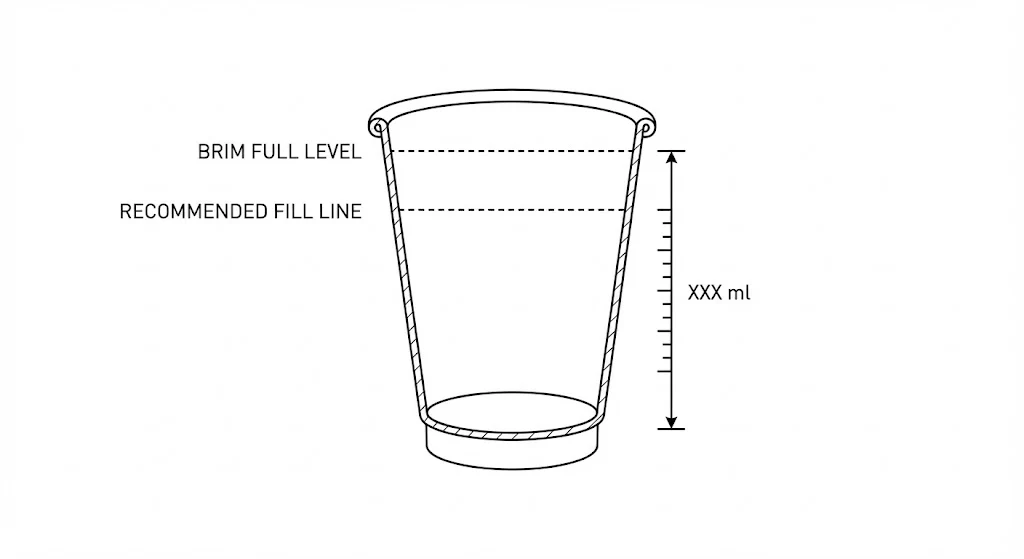
For commercial operations, fill-line capacity matters more. Overfilling leads to spills, lid leakage, and inconsistent beverage costs.
Accurate unit conversion is also essential:
1 US fluid ounce ≈ 29.57 ml (often rounded to 30 ml for simplicity).
For importers and manufacturers, even small measurement inconsistencies can create supply chain complications across international markets.
Standard Coffee Cup Sizes: Mugs vs Paper Cups
Although both serve the same function, ceramic mugs and disposable paper cups follow different sizing standards and operational logic.

Coffee Mugs (Dine-In)
Common commercial mug sizes include:
- 8 oz (240 ml)
- 10 oz (300 ml)
- 12 oz (350 ml)
- 15 oz (450 ml)
Mugs typically retain heat longer due to thicker walls and higher thermal mass. They are ideal for dine-in environments where customers spend more time enjoying their drinks.
However, mugs often hold slightly more liquid than advertised. Without strict portion control, this can gradually increase ingredient costs.
Operational considerations include:
- Washing and labor requirements
- Breakage risk
- Storage space
- Brand positioning and customer experience
Paper Cups (Takeaway)
Paper cups are standardized more strictly to ensure compatibility with lids and sleeves.
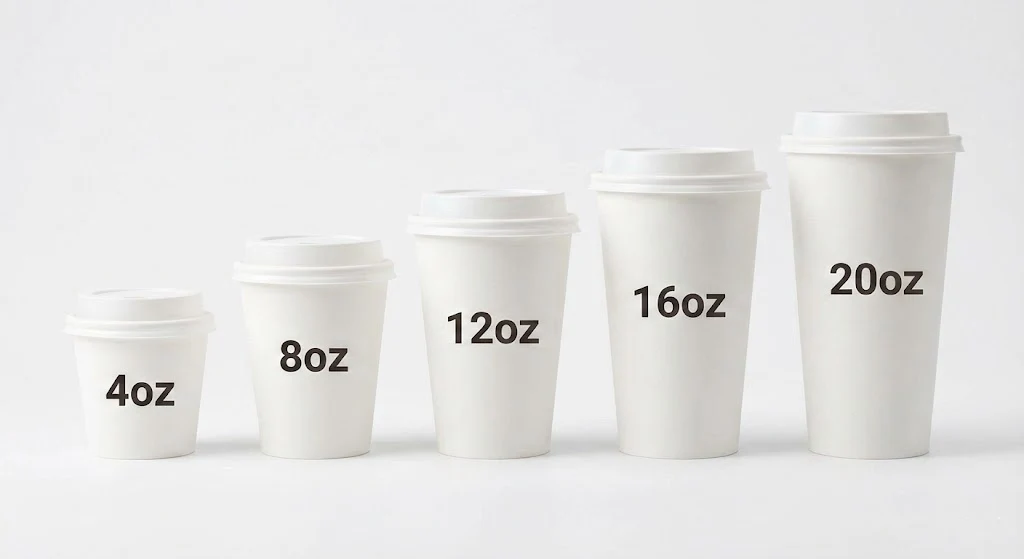
The most common takeaway paper cup sizes are:
- 4 oz
- 8 oz
- 12 oz
- 16 oz
- 20 oz
Unlike mugs, paper cup dimensions must align with standard lid diameters (such as 80mm or 90mm).
Paper cups are lightweight, stackable, and cost-efficient, making them ideal for high foot-traffic environments. However, they generally lose heat faster unless insulated construction is used (which will be discussed later).
How Coffee Cup Sizes Impact Business Performance
Coffee cup sizes shape how a business runs day to day. They affect drink cost, pricing flexibility, storage space, and purchasing stability. For cafés and wholesale buyers, sizing decisions quietly influence margins more than most operators expect.
Portion Control and Beverage Cost
Cup size sets the upper boundary for portion size. When that boundary is unclear or inconsistently managed, ingredient costs drift upward.
A 12 oz cup that regularly gets filled closer to the rim increases milk and syrup usage without any visible price adjustment. Across high daily volume, this difference compounds quickly. Small inconsistencies in fill level can translate into significant annual cost variance.
Size increments also matter. If the jump from 12 oz to 16 oz increases liquid volume substantially but the price increase is minimal, margin compression follows. Clear and proportional size steps help protect profitability while maintaining customer satisfaction.
For wholesale buyers, inconsistent size usage across clients makes reorder forecasting unstable and can distort demand planning.
Size Perception and Pricing Power
Customers judge size visually before they judge it numerically. A taller cup often feels like better value, even when the actual volume difference is moderate.

Well-structured size tiers create natural upgrade behavior. When the visual difference between small, medium, and large is obvious, customers are more likely to trade up. When the difference is subtle, upselling becomes harder.
Markets also respond differently. High takeaway markets often prefer larger visible formats, while specialty coffee environments can sustain smaller, more traditional sizes at premium pricing.
Cup size influences perceived value, and perceived value shapes pricing power.
Inventory Complexity and SKU Risk
Each additional size increases operational complexity.
More sizes mean more lids, more sleeves, more case packs, and more storage allocation. For cafés, this complicates training and increases ordering errors. For wholesale distributors, low-turnover sizes tie up warehouse space and reduce capital efficiency.
Reducing low-turnover sizes improves purchasing clarity and minimizes storage fragmentation. Operational simplicity often generates more stability than offering excessive variety.
Lid, Sleeve, and Accessory Compatibility
Volume alone does not define a cup specification. Rim diameter and structural dimensions determine whether lids seal properly and sleeves fit securely.
Minor inconsistencies between suppliers can create leakage issues or require separate lid inventories. Over time, these small mismatches increase purchasing complexity and emergency restocking costs.
Standardizing around compatible size families simplifies procurement and reduces operational friction.
Size Structure Models for Different Business Types
There is no single “best” coffee cup size system. The right structure depends on service style, menu complexity, and customer behavior. Businesses that choose sizes intentionally tend to operate more efficiently than those that simply copy large chains.
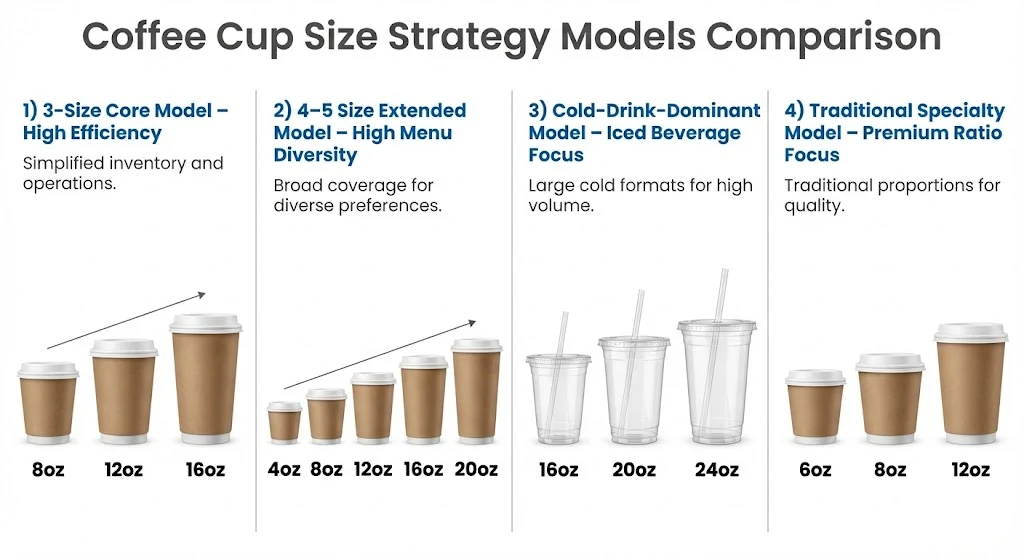
Below are common structural models used in real café and distribution environments.
The 3-Size Core Model
This is the most widely used structure:
8 oz
12 oz
16 oz
It covers the majority of espresso-based drinks, brewed coffee, and standard iced beverages. Operationally, it keeps inventory manageable while still offering clear price differentiation.
This model works well for:
- Independent cafés
- High-foot-traffic takeaway shops
- Wholesale programs supplying multiple small operators
It reduces lid variation, simplifies staff training, and improves purchasing predictability.
The 4–5 Size Extended Model
Businesses with broader menus sometimes add:
4 oz (espresso / sampling)
20 oz (large iced drinks)
This expands the system beyond the core three sizes. It allows better coverage for specialty beverages and premium upselling, but it also increases SKU complexity.
This structure fits:
- Large coffee chains
- Cafés with heavy cold beverage volume
- Wholesale buyers serving mixed client profiles
The trade-off is higher inventory management demands.
Cold-Drink-Dominant Model
In markets where iced drinks represent a large percentage of sales, the size distribution shifts upward.
16 oz becomes the baseline.
20 oz or 24 oz gains stronger demand.
Smaller hot sizes remain available but account for a lower share of total volume.
This model is common in:
- Warm climates
- Youth-oriented coffee brands
- Urban takeaway-focused concepts
It requires careful planning to avoid oversupplying low-demand hot sizes.
Traditional Specialty Model
Specialty coffee environments often emphasize smaller formats.
6–8 oz for cappuccino
8–12 oz for most drinks
Limited large-format offerings
This structure supports traditional beverage ratios and premium positioning. The emphasis is less on volume and more on flavor balance.
It works best in:
- Sit-down specialty cafés
- Markets with strong European influence
- Brands positioning around craft and quality
Each size model reflects a different operational priority. Once selected, the structure should remain stable to protect forecasting accuracy and purchasing consistency.

Single Wall vs Double Wall and Size Selection
Cup construction changes the economics of size.
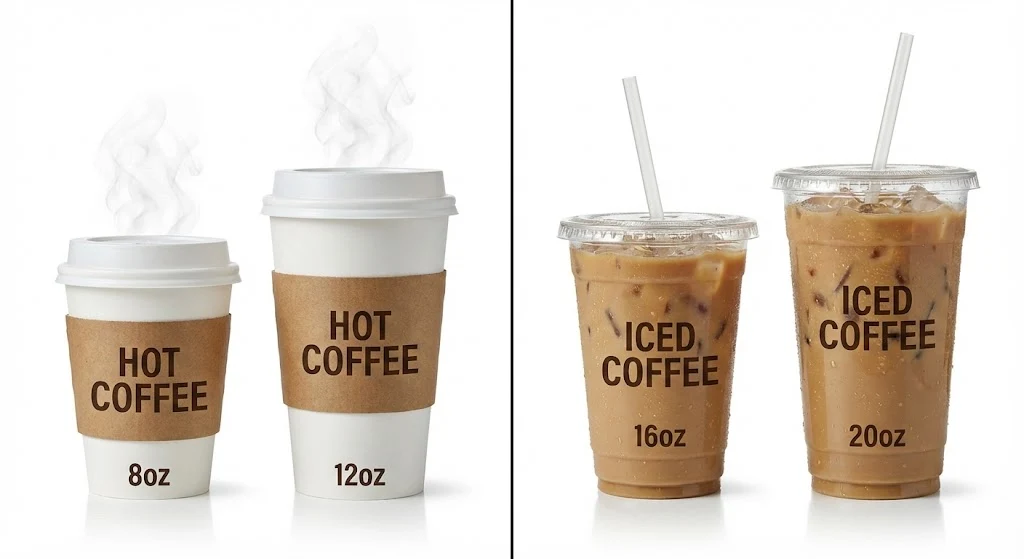
Single wall cups work efficiently in smaller formats where heat exposure time is short. As volume increases, heat retention and hand comfort become more noticeable, especially in 12 oz and 16 oz hot drinks.
Double wall construction becomes more relevant as cup size increases. Larger hot beverages hold heat longer and are carried further, which raises insulation expectations. The upgrade improves handling and perceived quality but increases unit cost and shipping weight.
The larger the cup, the more material choice affects margin. Size and wall structure should be evaluated together, not separately.
Building the Right Coffee Cup Size Mix for Your Business
Building the right coffee cup size mix is ultimately about long-term stability. For cafés, consistent coffee cup sizes protect margins, simplify daily operations, and support clear pricing tiers. For wholesale buyers, standardized size structures improve forecasting accuracy, reduce SKU fragmentation, and strengthen supplier coordination.
The most successful businesses do not chase variety. They build a controlled, scalable system around proven coffee cup sizes and let demand guide allocation within that framework. When size decisions are intentional rather than reactive, growth becomes more predictable and operational risk declines.