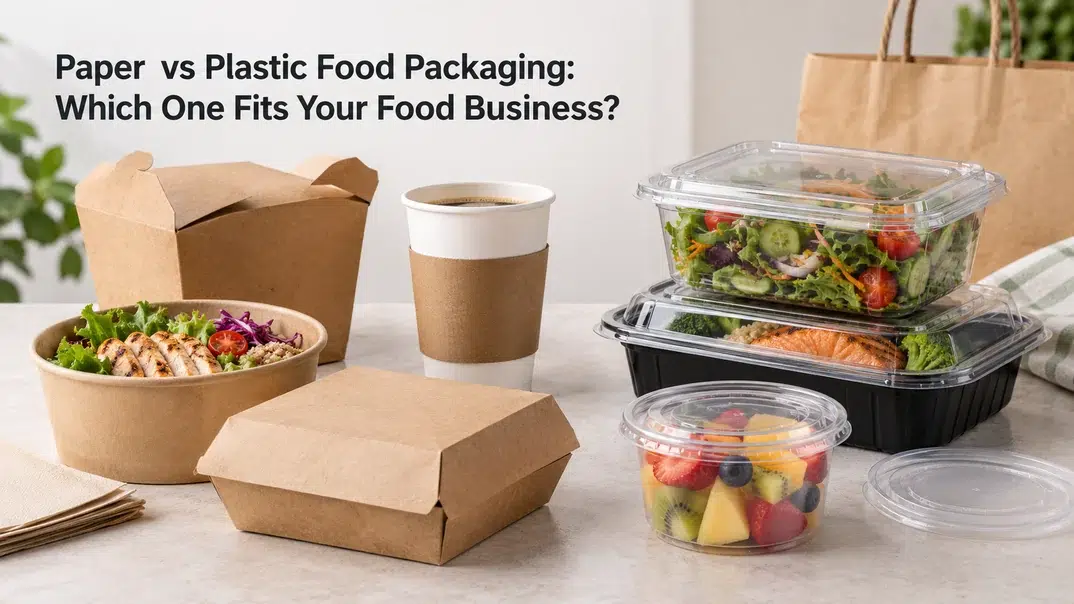
Paper vs plastic food packaging is usually treated as a sustainability choice. For a food business, performance comes first: the package must hold the right food, remain closed during handling, and fit the disposal route in the target market. Paper is often a good starting point for foldable boxes, trays, cups, and printed takeaway formats. Plastic can be useful for liquid, chilled, or highly visible products. The full construction decides the result.
The Material Name Is Not the Full Specification
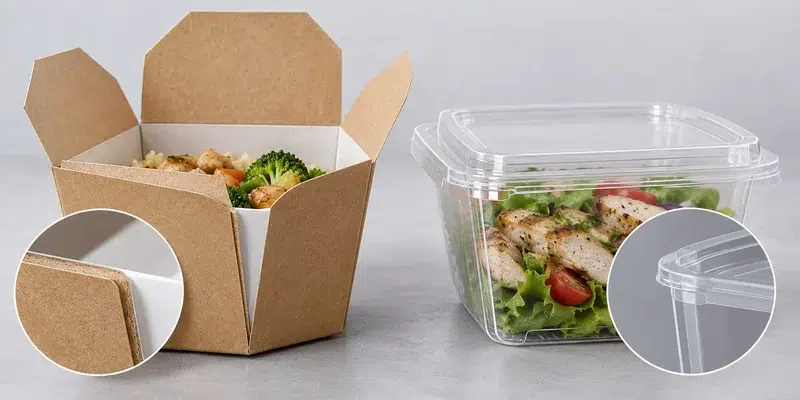
A “paper food container” usually includes paperboard, a coating or lining, folded panels, seams, and a lid. The paperboard creates the shape. The coating helps manage oil and water. The folds and seams provide strength. The lid controls how the package behaves when it is carried, stacked, or tilted.
A “plastic container” also describes a wide range of products. Resin type, wall thickness, rigidity, rim profile, hinge, snap points, and lid design can all change the result. A clear salad container and a rigid soup tub may both be called plastic packaging, but they solve different problems.
In practical packaging work, a request for “paper boxes” or “plastic containers” is only a starting point. A supplier still needs the food type, temperature, capacity, holding time, moisture, lid requirement, target market, and packing method before recommending a controlled version.
Use these questions to define the comparison:
- What material touches the food?
- Does the package need a coating, lining, or separate barrier?
- How much oil, water, sauce, steam, or condensation will it meet?
- How long will the food stay in the package?
- Will the order be stacked, tilted, shaken, refrigerated, or reheated?
- Does the lid need to be leak resistant, transparent, vented, or tamper evident?
- What waste collection route is available after use?
When Paper Food Packaging Is the Better Starting Point
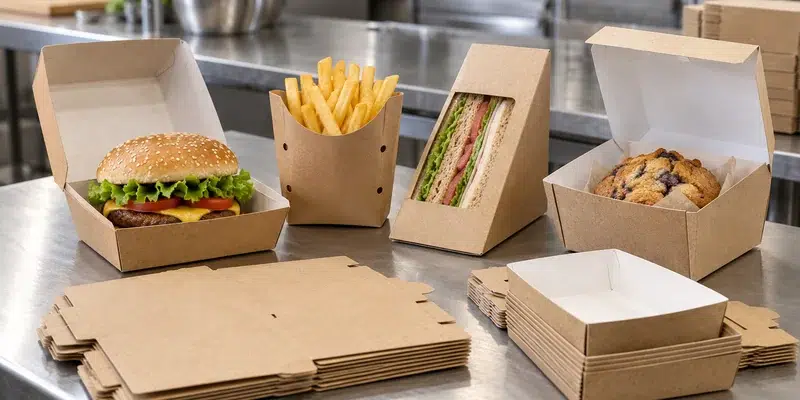
Paperboard is often a strong starting point for foods that benefit from ventilation, easy printing, and a package that can be stored flat before forming.
Common formats include burger boxes, sandwich boxes, pizza boxes, bakery boxes, paper trays, boat boxes, snack cones, takeaway cartons, paper bowls, and paper cups. These formats can be adapted to different food portions and service workflows. A printed paperboard surface also gives brands space for logos, instructions, product information, and handling marks.
Paper works especially well when the food has limited free liquid and the design can control steam. Fried food needs room for moisture to escape. A fully sealed box can trap condensation and reduce crispness, even when the box itself does not leak. Vents, openings, fold geometry, and the time between packing and eating all matter.
The limitation is that plain paperboard does not provide enough resistance to every food condition. Oil, sauce, water, and steam can weaken the board or move through seams when the construction is not suitable. A coated paper box may perform well for one menu item and fail for another with a longer holding time or heavier sauce.
For paper packaging, confirm the coating, food-contact side, seam design, lid closure, and actual portion before choosing a heavier board or changing the whole material.
When Plastic Food Packaging Is the Better Starting Point
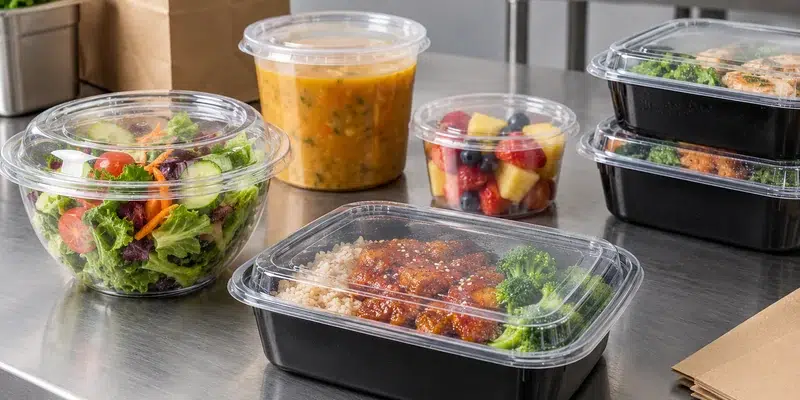
Plastic is often a useful starting point when the package needs a rigid shape, high moisture resistance, or clear visibility of the food.
Typical applications include soups, curry, sauced rice, noodles, chilled salads, fresh fruit, desserts, meal-prep portions, and foods that need refrigeration. A rigid base can support liquid contents during handling, while a clear lid can help staff and customers check the order without opening it.
Plastic does not remove the need for careful design. The rim and lid must engage correctly. Snap points, hinges, vent openings, and the condition of the lid can determine whether liquid escapes. A strong base with a poorly matched lid is still a weak delivery package.
Heat and cold performance also depends on the exact plastic and construction. Do not assume that a clear container is suitable for microwave use, hot filling, freezing, or long contact with a particular food. Confirm the intended use for the actual SKU and target market.
When plastic is the starting point, compare the complete container and lid set. Check the fit with the real fill level, because an empty-container test cannot show how pressure, weight, or food temperature will affect the closure.
Why Coating, Lids, and Seams Matter

Packaging performance is usually decided by the complete construction, not by the base material alone.
Paper packaging may use PE, PLA, water-based, or other coating systems. Single-sided and double-sided coatings protect different surfaces and may suit different food conditions. The choice depends on which side contacts food, whether the outside will meet condensation, how the package is formed, and what disposal route the target market supports. There is no single coating that is correct for every paper container.
For paper boxes, the locking tabs, corners, folds, glue points, and top opening must work together. For bowls and cups, the rim and lid need compatible dimensions. For plastic containers, the sealing area, snap points, hinge, and lid stiffness need the same attention.
At Million Pack, this is why a sample is treated as a specific version. A change to the coating, material, die line, lid, size, or artwork can change the result and should be recorded before production.
Food-contact review also covers coatings, adhesives, colorants, and other packaging components. The FDA information on food packaging and food-contact substances explains why the intended use and possible migration of food-contact substances must be considered.
For a closer look at two common paper-cup coating choices, see Million Pack’s article on PLA vs PE coating.
Match the Package to the Food
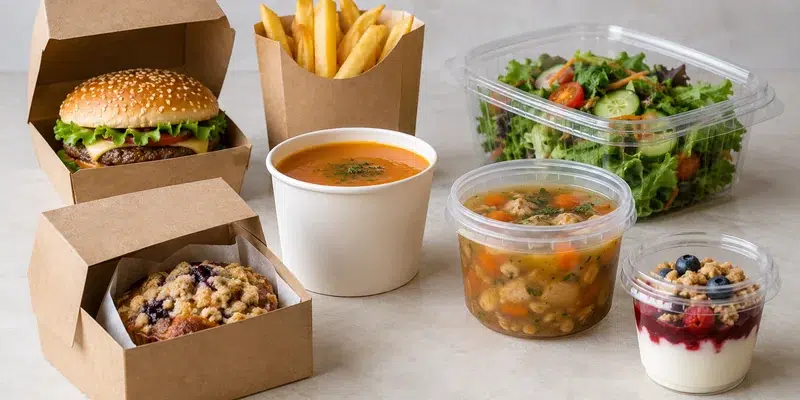
The right material depends on the food’s behavior inside the package. Use the table below as a starting point for sampling, not as a universal specification.
| Food type | Format to evaluate first | What to check |
|---|---|---|
| Burgers and sandwiches | Paperboard box or wrap with suitable ventilation | Grease resistance, steam release, compression in a delivery bag |
| French fries and fried snacks | Paper tray, cone, or vented paper box | Oil contact, condensation, crispness, opening size |
| Rice, noodles, and sauced meals | Coated paper bowl or box, or a rigid plastic container | Corner strength, sauce leakage, lid fit, holding time |
| Soup and curry | Paper soup cup with a matched lid, or a rigid plastic container | Fill temperature, tilt resistance, rim seal, steam and pressure |
| Salads and cold meals | Coated paper bowl or clear plastic container | Condensation, lid closure, refrigeration, product visibility |
| Bakery and dry foods | Paper box, tray, or window box | Grease marks, moisture transfer, product protection |
| Ice cream and chilled desserts | Paper cup or plastic container designed for cold use | Condensation, low-temperature flexibility, lid fit |
Other fiber formats can also be considered. Million Pack’s product range includes natural-fiber and bagasse bowls, plates, and trays. These are separate constructions with their own moisture behavior, forming limits, documentation, and testing requirements. They should not be treated as interchangeable with either a paperboard box or a plastic container.
Sustainability Depends on the Full Construction
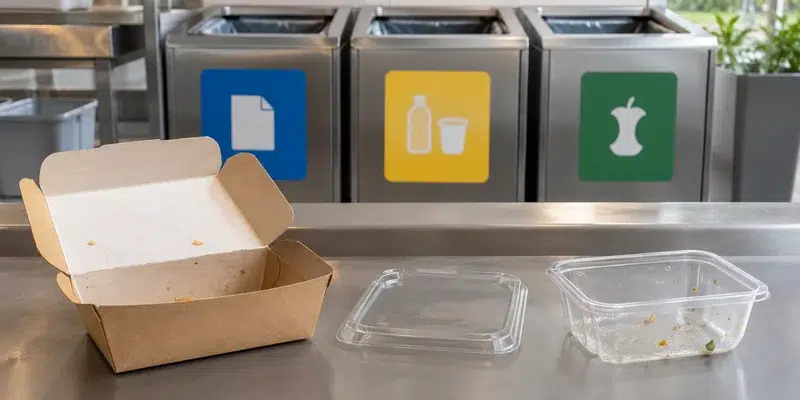
Paper is not automatically the better choice, and plastic is not automatically the worse one. The useful question is whether the complete package performs well, uses an appropriate amount of material, and has a realistic end-of-life route in the target market.
A paper box or cup may contain a polymer lining. A paper package may also use a separate plastic, CPLA, or clear lid. A plastic container may be accepted by one local collection program and rejected by another. Food residue can create another barrier to recycling or composting.
Before using terms such as recyclable, compostable, biodegradable, or eco-friendly, confirm:
- The material in the base, coating, lid, window, label, and adhesive
- The exact SKU and version covered by the document or certification
- The food and use conditions covered by the claim
- The waste facilities available in the target market
The EPA guidance on accepted recycling materials advises businesses to check local recycling and composting programs for specific materials. In practice, a packaging claim must match the actual product and the local collection route. A catalog icon or a material name alone does not prove that every size, coating, lid, or supplier version has the same status.
Compare the Full Packaging System, Not Unit Price
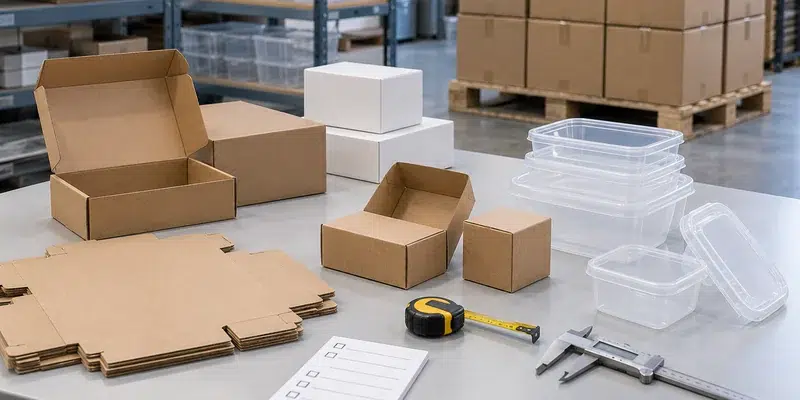
The price of one container does not show the full cost of a packaging program.
Many paper boxes arrive flat and need forming or setup before use. Plastic containers are often nested, but they can occupy more space depending on the shape and lid. Case pack, carton dimensions, pallet arrangement, and shipping volume can change the result.
When comparing two quotations, align the specifications first:
- Food type, capacity, and internal dimensions
- Base material, coating, and food-contact side
- Lid, closure, vent, window, and inner-tray requirements
- Printing, artwork coverage, tooling, and sample approval
- Case pack, carton size, outer-carton strength, and loading plan
- First order, expected annual use, destination, and trade terms
A supplier may use different production or sourcing routes for different SKUs, sizes, structures, or materials. The fact that one item is available does not prove that every product in the same category follows the same route. Confirm the current SKU, controlled sample, production source, and documentation before making a purchasing decision.
Packaging failure also has a cost. Leaks, crushed containers, soggy food, rejected orders, and replacement shipments can outweigh a small difference between materials. A lower unit price is useful only when the package still protects the food and fits the operating process.
Test the Actual Package Before Ordering
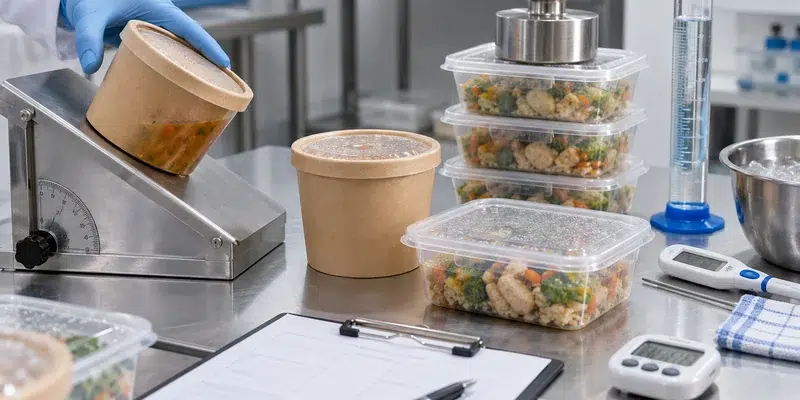
A sample should represent the final package. An uncoated paper sample, an old lid, or a different size cannot approve the production version.
- Define the operating conditions. Record the food, temperature, portion, holding time, delivery distance, stacking method, and expected movement.
- Use the final structure. Test the actual paperboard, coating, plastic, lid, dimensions, and forming method.
- Fill it with real food. Water-only testing may miss the effects of oil, sauce, steam, particles, and condensation.
- Check the intended holding period. Inspect the package immediately and again after the food has been held for the expected time.
- Simulate delivery handling. Tilt the package, stack filled units, move the bag, and inspect the lid, seams, corners, and base.
- Record the version. Keep the material, coating, dimensions, artwork, packing method, date, and approval status together.
- Retest after a change. A new lid, coating, die line, size, or material can change the result.
Quality checks should cover the package as it will be used. Depending on the product, this may include incoming-material checks, production checks, finished-product checks, hot-water or leak testing, and lid-fit inspection. The method and acceptance conditions should be clear before the sample is approved.
For Million Pack, the most useful supplier inquiry includes the food type, hot or cold use, capacity, dimensions, holding time, oil and water exposure, condensation, microwave or refrigeration needs, food-contact materials, lid or inner-tray requirements, print details, target market, tests, carton information, and expected volume.
Questions to Ask Before Ordering
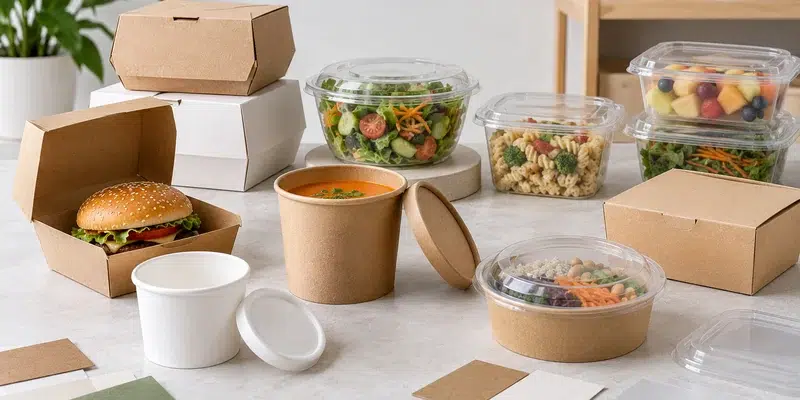
Send enough information for the supplier to recommend a complete structure from the start.
- Which paperboard, plastic, fiber, coating, or lining is proposed?
- Which surface touches the food?
- What food, temperature, oil, water, and holding time was the sample designed for?
- Which lid or closure is matched to the base?
- What tests will be performed before approval?
- Will a change to the lid, coating, size, or artwork require a new sample?
- What are the carton dimensions, case pack, loading method, and destination requirements?
- Which documents support the food-contact and environmental claims for the exact SKU?
Is paper better than plastic for takeout?
Paper is often a good starting point for dry, fried, bakery, and printed takeaway formats. Plastic can be a better starting point for liquid, chilled, or highly visible foods. The complete package and disposal route decide the final choice.
Can paper food containers hold soup?
Some can, when the paperboard, coating, seams, and lid are designed for hot liquid use. Confirm the exact product with real soup, the intended fill temperature, the holding time, and delivery handling.
Is paper packaging always more sustainable?
No. Coatings, lids, food contamination, local collection, and the actual product documentation all affect the result. Use the complete package and the target market’s waste system as the basis for the claim.
Is plastic packaging always leak resistant?
No. A plastic container can leak through a weak rim, poor lid fit, damaged hinge, or unsuitable closure. The base and lid need to be tested together at the actual fill level.
What information does a supplier need before quoting?
Provide the food, temperature, capacity, dimensions, holding time, oil and water exposure, lid, printing, target market, testing, packing, destination, and expected volume. A product photo by itself is not enough to confirm a suitable structure or accurate quotation.
Conclusion: Paper and plastic each solve different packaging problems. The better choice is the one that protects the food, works with the kitchen and delivery process, matches the target market’s requirements, and can be supported by the right product information. Start with the food and operating conditions, then confirm the material, coating, lid, sample version, testing method, packing data, and disposal route before production.