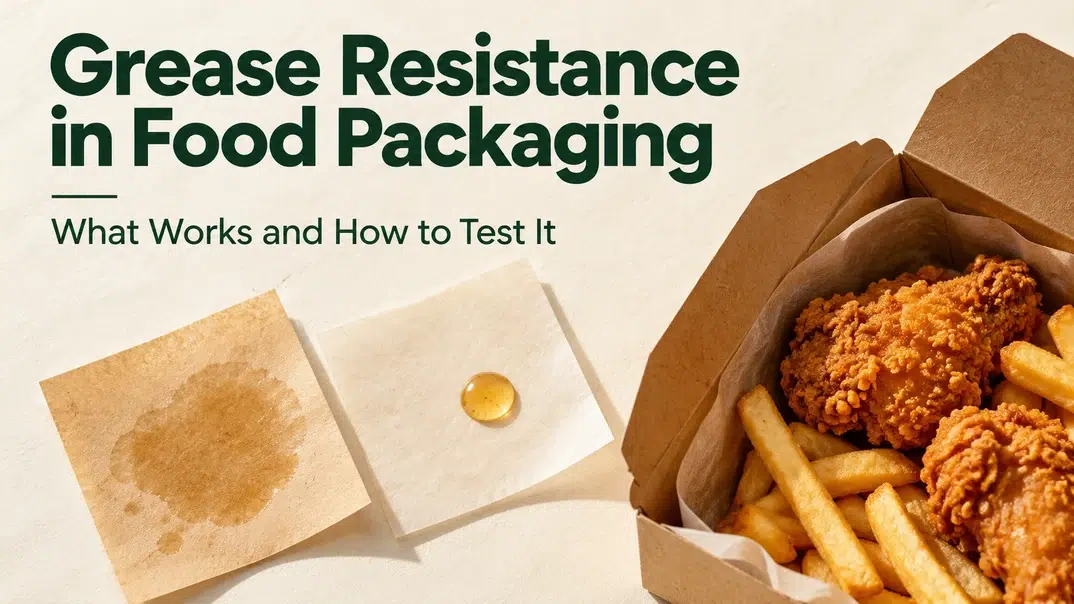
Grease resistance in food packaging means a wrap, carton, or tray can slow oil from reaching its outside during its intended use. A pack may look clean when you fill it, then stain a delivery bag after sitting with hot food. To avoid that, you need to look at the food, the barrier material, and the finished pack—not just a claim printed on a sample sheet.
This guide shows you where grease usually gets through, which packaging structures can help, and how to check whether a pack works for your menu.
What Does Grease Resistance Mean?
A grease-resistant pack delays the movement of fats and oils through the food-contact surface. The useful question is how long it stays clean with your food, at your serving temperature and during your normal holding or delivery time. “Grease-resistant” does not mean no oil can ever pass through.
Oil resistance is also different from resistance to water or thin sauces. A carton that contains fryer oil well may still leak sauce through a corner. If your food has both oil and free liquid, test both problems separately.
Where Does Grease Get Through a Paper Pack?
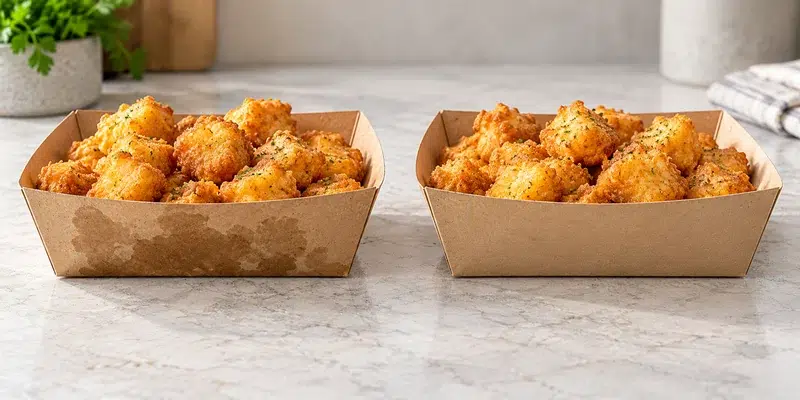
Grease can enter exposed paper fibers at the food-contact surface. Heat and longer contact give oil more opportunity to move into the sheet. But a good flat-sheet result does not settle the question for a finished box.
Look closely at these areas:
- Folds and score lines: Bending can weaken a barrier layer or expose fibers at a crease.
- Cut edges: An unprotected edge can wick oil even when the main panel remains clean.
- Corners and glued seams: Overlapping panels, gaps, and food trapped against a corner can create a local weak point.
- Food contact points: A pastry sitting in one spot or fried chicken pressed against a side wall creates a different exposure from a quick wrap around a sandwich.
This is why we consider the coating, converting steps, and box shape together. If a sheet passes a test but the assembled carton stains, changing the whole material may be unnecessary; the crease, corner, or liner position could be the real issue.
Which Packaging Materials Help Resist Grease?
There is no single best material for every oily food. The right structure depends on whether you need a flexible wrap, a rigid carton, or a container that must also hold moisture.
- Dense greaseproof paper: A practical wrap or liner for burgers, pastries, and fried foods when you need close contact with the food. Its grade and intended contact time still matter. See how greaseproof paper differs from ordinary wrapping paper.
- Barrier-coated paperboard: PE, PLA, and some water-based coatings can reduce oil penetration when the formulation and coat coverage suit the job. Check whether the coating remains effective after scoring and folding.
- A liner plus a structural box: For a hot, oily item, a suitable liner can take the direct grease contact while the outer carton provides shape and handling strength. That can be more targeted than specifying the same barrier across every panel, but the liner has to stay in place during service.
- Treated molded fiber: Trays and clamshells can be made with oil-resistant treatments, but their performance varies by formulation and forming details. Test the actual product; the fiber material itself is not automatically greaseproof.
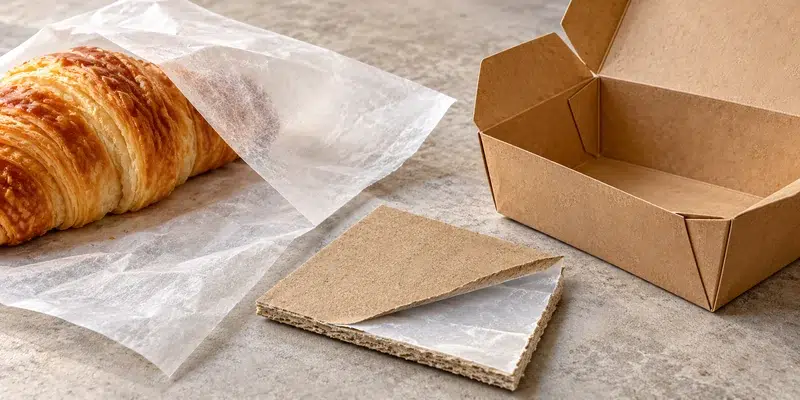
For example, a fries carton needs to limit visible oil marks where hot fries rest against the walls. A pastry box may need only a suitable liner under the product. A saucy fried meal asks for oil resistance and liquid containment, so its closure and seams need separate attention.
How Is Grease Resistance Measured?
Ask what a reported result actually measures. A bare statement such as “high grease resistance” gives you no way to compare materials.
The TAPPI T559 Kit test reports a numbered result, up to 12, based on which test liquid a treated paper surface repels under the method. It is useful for certain paper treatments, but a Kit number is not a promise that a food box will stay clean for that many minutes. Check whether the method is suitable for the barrier you are comparing.
ISO 16532-1 measures how long a grease simulant takes to penetrate paper or board. It can examine creased as well as uncreased material. That difference matters when your package is folded into a tray or box. These grease resistance tests help you compare samples, but they do not replace a trial with the actual food and finished package.
When you review a test report, check the method, material version, test conditions, and whether the sample was flat or creased. Two results measured in different ways should not be treated as equivalent.
How Can You Check a Finished Pack With Your Food?
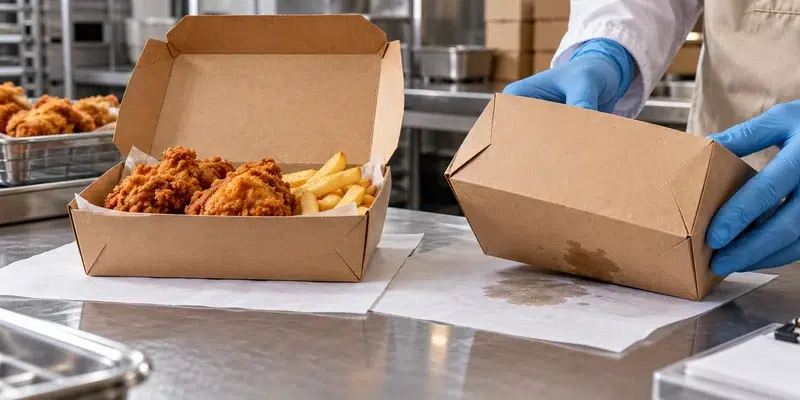
Use the food that gives you the most trouble, not an easy sample. Pack it at normal serving temperature and leave it for the longest realistic hold or delivery period. Put the finished pack on clean absorbent paper so small exterior marks are easy to see.
Then inspect three things:
- The outside: Are there translucent oil spots on the bottom or side walls?
- The weak points: Is oil appearing first at a fold, cut edge, seam, or liner gap?
- Handling: Does the pack still hold its shape when lifted, closed, and placed in a delivery bag?
Keep the approved sample and note its board, barrier, liner, and box design. If any of these change, repeat the food trial. A change in coating, scoring, or folding can affect the barrier even when the new box looks the same.
What About PFAS and Food-Contact Claims?
An oil barrier is not automatically suitable for food contact, and “PFAS-free” does not tell you how well it resists grease. Check the exact food-contact construction and the conditions of use for the market where you sell.
In the United States, the FDA says the authorizations for 35 PFAS-related food-contact notifications once used for grease-proofing paper and paperboard are no longer effective. That is a specific U.S. regulatory development, not a blanket statement about every coating or every country. For a new barrier option, verify its current food-contact documentation and test its performance with your food.
FAQs
Can One Grease-Resistant Pack Work for Both Hot Fries and Cold Pastries?
Possibly, but do not assume it. Hot fries, butter-rich pastries, and chilled foods expose the barrier to different fats, temperatures, and contact times. Test each menu use that matters to you before standardizing on one pack.
Is a Grease-Resistant Box Safe for a Microwave or Oven?
Grease resistance alone does not establish heat-use suitability. The board, coating, adhesive, ink, and finished construction all need to be appropriate for the heating method and conditions. Use the pack for reheating only when that exact design is documented for it.
Can I Print on Grease-Resistant Packaging?
Often, yes, but the print process and ink placement must suit the barrier and the intended food-contact use. Check the final printed and folded pack: a clean unprinted sample does not prove that a changed production version will perform the same way.
Conclusion
Choose grease resistance for the food and service time you actually have. Compare suitable wraps, coated boards, or liners, then check the finished pack at its folds and seams with real food. A clean flat sheet is a useful start; a clean package at the end of delivery is the result you need.