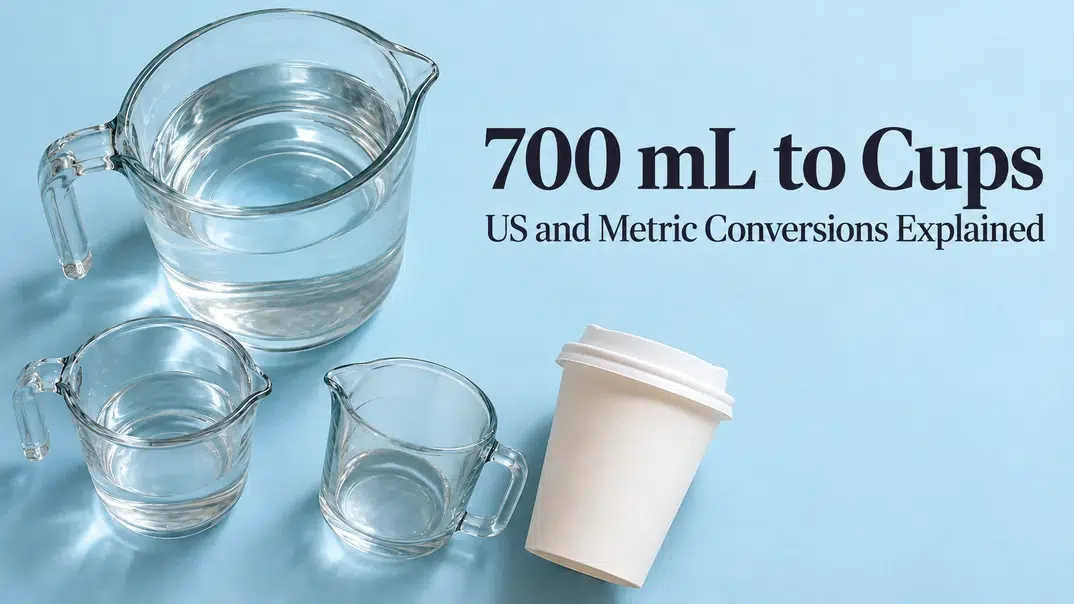
700 mL is about 2.96 US cups, a little less than three full cups. If your recipe uses a 250 mL metric cup, it is 2.8 cups. It is also about 23.67 US fluid ounces. If you are matching a 700 mL serving to takeaway packaging, that puts you near a 24 fl oz label—but the labeled size alone cannot tell you whether the serving will fit under a lid.
How Many US Cups Is 700 mL?
700 mL equals approximately 2.96 US customary cups. One US cup is about 236.588 mL, so the calculation is 700 ÷ 236.588 = 2.9587. Round that to 2.96 cups for a recipe or menu conversion. The US cup conversion factor is based on 8 US fluid ounces per cup.
Three US cups would be about 709.8 mL. For a casual recipe, “just under three cups” is usually enough. If you are portioning drinks or food for service, measure 700 mL directly so each sample starts at the same volume.
Why Do Some Converters Say 2.8 or 2.92 Cups?
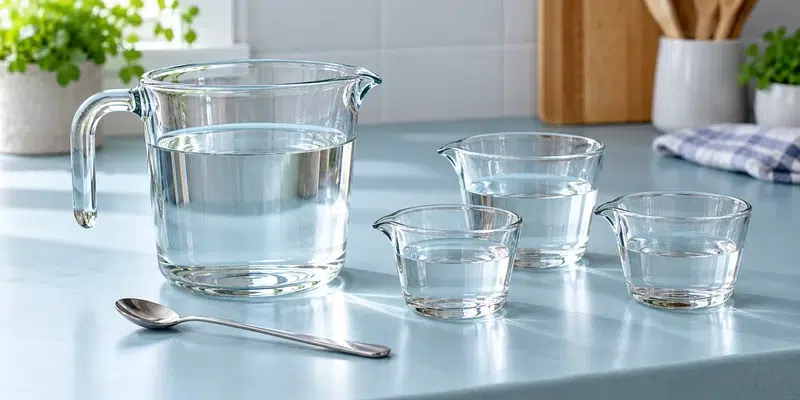
They are using different cup volumes. A 250 mL metric cup gives 700 ÷ 250 = 2.8 cups. A 240 mL kitchen shortcut gives 700 ÷ 240 ≈ 2.92 cups; 240 mL is a rounded reference for a US cup, not its precise volume. Some recipes use that convenient rounding, while others use the full US customary conversion.
| Cup reference | Volume per cup | 700 mL equals |
|---|---|---|
| US customary cup | About 236.588 mL | About 2.96 cups |
| Rounded 240 mL kitchen reference | 240 mL | About 2.92 cups |
| Metric cup | 250 mL | 2.8 cups |
If a recipe or product specification does not say which cup it means, keep the amount in mL until you can confirm the standard. A 250 mL metric measuring cup gives a different answer from the US cup used above.
How Do 24 fl oz, 750 mL, and 26 fl oz Compare?
They are nearby volume references, but none equals 700 mL. The table uses US fluid ounces, which measure volume; an “oz” label can be ambiguous if it does not specify fluid ounces.
| Size reference | Unit-equivalent volume | Difference from 700 mL |
|---|---|---|
| 700 mL | 23.67 US fl oz | — |
| 24 US fl oz | 709.8 mL | 9.8 mL more |
| 750 mL | 25.36 US fl oz | 50 mL more |
| 26 US fl oz | 768.9 mL | 68.9 mL more |
| 28 US fl oz | 828.1 mL | 128.1 mL more |
For a 700 mL liquid-only drink, 24 fl oz offers just 9.8 mL of difference on paper. That is too small to assume useful space for a lid or delivery movement. A 750 mL or 26 fl oz reference gives more room mathematically, but even those numbers do not establish the usable capacity of a particular cup, bowl, or lid combination. Check the actual product’s capacity definition and a filled sample.
Which Container Type Works for a 700 mL Portion?
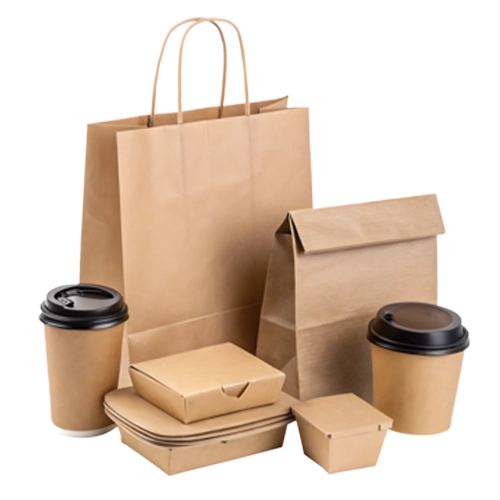
Match the format to what you are serving, then check its usable fill. Million Pack’s product range includes paper cups, transparent cold cups, soup bowls, and food boxes. These are formats to compare, not a claim that every range has a current 700 mL SKU.
| You are serving | Format to compare | Check on the filled sample |
|---|---|---|
| Iced drink, smoothie, or milk tea | Large cold-use paper cup or transparent cold cup | Count ice and toppings in the finished volume; check lid clearance and how the drink handles when carried. |
| Hot drink | Hot-use paper cup with its matching lid | Check the serving temperature, usable fill, lid fit, and how comfortably you can hold the filled cup. |
| Soup or noodles with broth | Lidded soup bowl | Fill with the actual mix of liquid and solids; check the lid and seams after the expected holding and delivery time. |
| Salad, rice, or mixed meal | Wide-mouth paper bowl or food box | Check whether the food fits without being compressed and whether the lid closes over toppings. |
A volume conversion is most useful for liquids. A 700 mL scoop of salad or noodles can sit very differently from 700 mL of water, so the opening, depth, and food shape matter as much as the stated capacity. If you need a specific coating, clear-cup material, or hot-use performance, confirm it for the chosen product and its intended use.
How Do You Check the Usable Capacity of a Cup?
Prepare the exact 700 mL serving and close the matching lid. First decide whether 700 mL means liquid alone or the finished drink with ice, foam, or toppings. A “700 mL drink” prepared both ways may need different cups.
For cup-and-lid checks, we look at three things together:
- Room below the rim: Does the lid close without touching the drink or toppings?
- Lid fit: Does the lid stay seated on that cup’s rim? Matching ounce labels do not prove that lids are interchangeable.
- Handling: Can you lift, carry, and tilt the prepared cup in the way your staff and customers will use it?
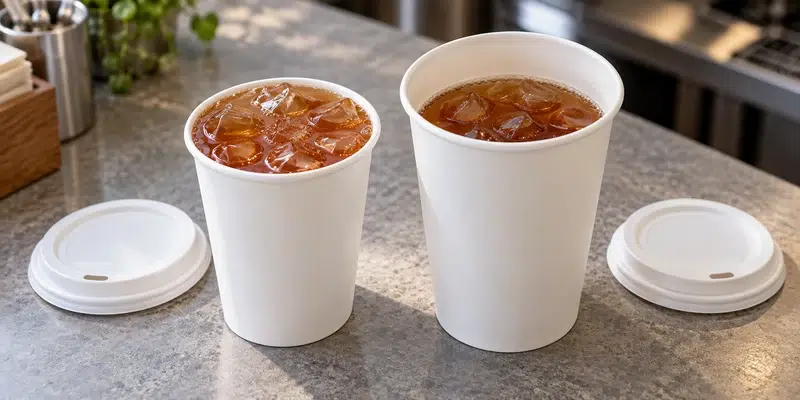
A nominal 24 fl oz cup may be too tight for a full 700 mL liquid pour. If the 700 mL figure already includes ice, its fit may be different. Record the fill level, cup model, and matching lid you tested; if you change the cup or lid, repeat the check. Our paper cup size guide explains the dimensions behind those size labels.
For food rather than drinks, use the same approach with the prepared dish and the bowl or box named in your packaging specification. A water-only test will not show whether noodles, rice, or toppings prevent the lid from closing.
FAQs
Is 700 mL the Same as 700 g?
No. Milliliters measure volume; grams measure weight. Water is close to 700 g for 700 mL under ordinary kitchen conditions, but other ingredients can weigh very differently. Use an ingredient-specific weight or a scale if your recipe is in grams.
Can I Use a 24 oz Paper Cup to Measure 700 mL?
No, not accurately unless it has verified volume markings. “24 oz” is a size description, not a calibrated measuring line. Use a graduated measuring jug to portion 700 mL, then use the paper cup to test how that portion fits during service.
Conclusion
For a US recipe, 700 mL is 2.96 cups; for a 250 mL metric cup, it is 2.8 cups. For takeaway service, compare nearby size labels, then check your actual serving in the correct cup, bowl, or box with its matching lid. Keep the 700 mL target in the specification so the unit conversion does not turn into a mistaken product-capacity claim.