The global paper cup market continues to grow, but opportunities vary by region, product type, and application. Understanding demand, pricing, materials, and market trends can help manufacturers and buyers make better sourcing and product decisions. This global paper cup market analysis provides a clear view of the market size, production, regional growth, and future direction of the paper cup industry.
Global Paper Cup Market Analysis
The global paper cup market remains a large and steadily growing part of the foodservice packaging industry. Growth comes from both higher consumption and a gradual shift toward higher-value products. The continuous global expansion of coffeehouse chains, alongside a booming “on-the-go” consumption culture, serves as the primary volume driver.
Market Size and Growth Forecast
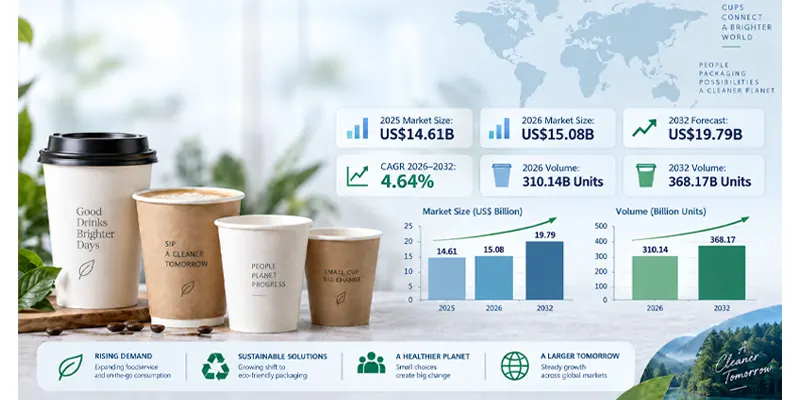
According to APO Research, the global paper cup market was valued at about USD 14.61 billion in 2025 and is expected to reach USD 15.08 billion in 2026. By 2032, the market is projected to grow to approximately USD 19.79 billion, with a CAGR of around 4.64% from 2026 to 2032.
The market is therefore expanding steadily rather than explosively. More importantly, growth is coming from both higher cup consumption and a gradual shift toward higher-value cup structures, coatings, printing, and applications.
| Indicator | 2025 | 2026 | 2032 |
|---|---|---|---|
| Market value | USD 14.61 bn | USD 15.08 bn | USD 19.79 bn |
| Sales volume | 303.23 bn cups | 310.14 bn cups | 368.17 bn cups |
| Average price | USD 48.18 / 1,000 cups | USD 48.61 / 1,000 cups | USD 53.76 / 1,000 cups |
Unit sales are growing more slowly than market value. This means future growth will come not only from selling more cups, but also from changes in product mix, materials, printing, and cup specifications.
Sales Volume Is Growing More Slowly Than Market Value
Global paper cup sales are expected to increase from about 310.14 billion cups in 2026 to 368.17 billion cups in 2032, equal to annual volume growth of roughly 2.90%. This is noticeably lower than the 4.64% growth in market value.
The difference is important. It shows that the market is not growing only because more cups are being used. Average selling prices and product mix are also moving upward. At the same time, paperboard, energy, labor, printing, and coating costs continue to affect selling prices.
Global Paper Cup Production and Capacity
Global paper cup production capacity is currently sufficient to meet market demand.
In 2025, effective global production capacity was about 394.62 billion cups, compared with sales volume of around 303.23 billion cups. This represents a capacity utilisation rate of approximately 76.84%.
In 2026, effective capacity is expected to increase to around 402.56 billion cups as manufacturers add new forming equipment and improve production efficiency.
However, installed machines do not equal usable capacity. Actual output also depends on:
- cupstock paperboard supply;
- printing and die-cutting capacity;
- side-seam sealing quality;
- bottom-forming accuracy;
- machine uptime;
- labour efficiency.
This means the global market is not limited by forming capacity alone. Production efficiency and supply-chain stability remain equally important.
Paper Cup Raw Materials and Material Consumption
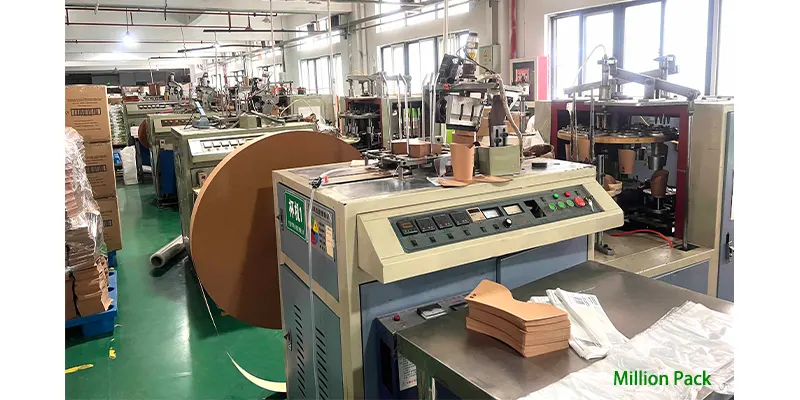
Paperboard is the main material used in paper cup production, while barrier coatings provide resistance to water, oil, and moisture. Virgin fibre remains widely used for direct food-contact cups because stiffness, cleanliness, and dimensional stability are important for high-speed forming and leak resistance.
Common barrier materials include:
- LDPE;
- PLA;
- bio-based PE;
- water-based coatings;
- PP and other specialised coatings.
Global paper cup production used around 3.18 million tonnes of paperboard, coatings, and related structural materials in 2025. This is expected to rise to approximately 3.26 million tonnes in 2026 and 3.88 million tonnes by 2032. Average material use is around 10.5 grams per cup, but actual consumption varies by cup size and structure. Single-wall cups generally use less material, while double-wall, ripple-wall, cold-drink, and dessert cups require more paperboard and coating.
Paper Cup Pricing Trends
Paper cup prices are influenced by both raw material costs and product structure. The global weighted average price was around USD 48.18 per 1,000 cups in 2025 and is expected to increase to approximately USD 48.61 in 2026. By 2032, the average price may reach about USD 53.76 per 1,000 cups.
Several factors influence paper cup pricing:
- paperboard prices;
- barrier coating costs;
- energy and labour;
- printing requirements;
- cup size and wall structure;
- production efficiency;
- transport costs.
Standard single-wall cups remain highly price competitive. Higher-specification products such as double-wall cups, ripple-wall cups, cold-drink cups, and custom-printed cups usually require more material and processing, which supports higher selling prices. This is one reason market value is expected to grow faster than total sales volume.
What Is Driving Paper Cup Market Growth?
Paper cup market growth is being supported by changes in foodservice, beverage consumption, and packaging choices. Demand is not coming from one source, but from several connected trends.
Growth of Takeaway Coffee and Tea
Coffee shops, tea chains, bakeries, and convenience stores remain major users of paper cups. The continued expansion of takeaway beverage consumption supports steady demand, especially in urban markets where consumers increasingly buy drinks for consumption outside the store.
Growth in Convenience Retail and Food Delivery
Convenience stores, petrol stations, food delivery platforms, and ready-to-eat food services are increasing the use of disposable beverage and food containers. This creates additional demand beyond traditional cafés and restaurants.
Rising Demand in Emerging Markets
Much of the new volume growth is coming from Asia-Pacific, the Middle East, and Latin America. Expanding coffee and tea chains, urbanisation, modern retail, and growing foodservice consumption are increasing paper cup use in these regions.
Shift Away from Some Plastic and Foam Products
Restrictions on plastic and expanded polystyrene foodservice packaging in some markets are encouraging businesses to consider paper-based alternatives. This can support demand for paper cups, particularly in cold drinks and takeaway foodservice.
Higher-Value Cup Formats
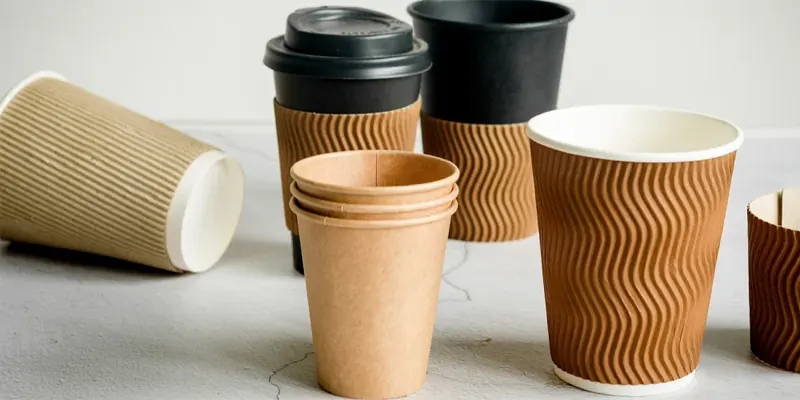
Market growth is also being supported by changes in product mix. Double-wall cups, ripple-wall cups, custom-printed cups, and higher-specification cold-drink cups use more materials and processing than standard single-wall products. As these products take a larger share of the market, market value can grow faster than total cup volume.
Overall, future growth will depend on both higher foodservice consumption and a shift toward more specialised, higher-value paper cup products.
Restraining Factors in the Paper Cup Industry
Paper cups have a stable place in foodservice, but that does not mean the market grows without pressure.

Reusable Packaging Policies
One of the biggest questions is simple: will people keep using as many disposable cups as before? Reusable cup programs, single-use fees, and waste-reduction policies are already encouraging businesses to reduce disposable packaging.
Raw Material Cost Pressure
Paper cups may look simple, but their cost depends on paperboard, coatings, inks, energy, and labour. When these costs rise, manufacturers cannot always raise prices at the same speed, especially when customers can easily compare similar products from different suppliers.
Recycling Limitations
A cup can be designed to be recyclable, but that does not always mean it will actually be recycled. Local collection systems, sorting facilities, coating types, and paper mills all matter. This gap between “recyclable in theory” and “recycled in practice” remains a challenge for the industry.
Strong Price Competition
Standard paper cups are easy to compare, so price competition can become intense. If two suppliers offer similar sizes, materials, and printing, buyers will naturally look at price, lead time, and service. This makes it harder for manufacturers to protect margins on basic products.
Higher Cost of New Materials
New materials can improve sustainability, but they are not always cheaper. Water-based coatings, PLA, PHA, and alternative fibers may increase material costs or require production changes. For price-sensitive buyers, that extra cost can slow adoption.
Competition from Other Packaging
Paper cups are not competing only with other paper cups. Reusable cups, plastic cups, molded-fiber packaging, and other beverage formats are all part of the same decision. In the end, buyers choose based on cost, performance, regulation, convenience, and local waste systems.
Regional Paper Cup Market Analysis
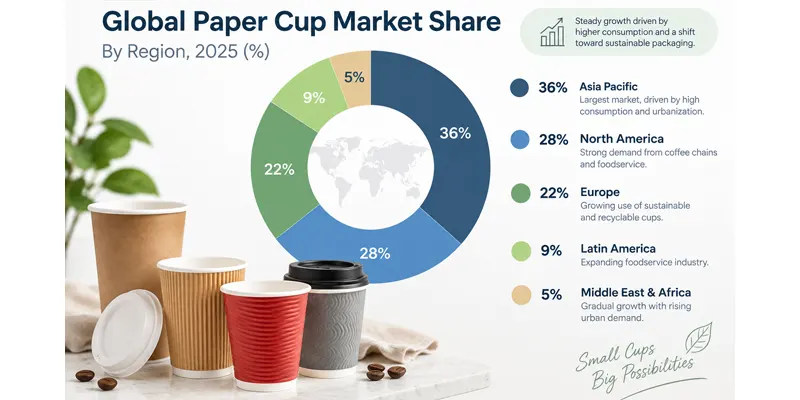
Paper cup demand varies significantly by region. Mature markets are shaped more by established foodservice systems and packaging regulation, while emerging markets are growing through urbanisation, beverage chains, and expanding takeaway consumption.
North America
North America remains one of the largest paper cup markets. Demand is supported by a strong coffee culture, large quick-service restaurant networks, convenience stores, and drive-thru consumption.
The region also has steady demand for double-wall, insulated, and custom-printed cups, especially from major coffee and foodservice brands. Mature distribution networks and high per-capita takeaway consumption help keep overall demand relatively stable.
Europe
The European market is strongly influenced by packaging regulation and sustainability requirements.
The EU Single-Use Plastics Directive and wider efforts to reduce plastic use are encouraging changes in paper cup materials and barrier coatings. As a result, more suppliers are developing cups with PLA, water-based coatings, and other lower-plastic or fibre-based solutions.
At the same time, reusable cup systems and single-use packaging reduction policies may limit overall consumption in some markets.
Asia-Pacific
Asia-Pacific is one of the fastest-growing regions for paper cup demand.
Growth is being driven by urbanisation, expanding coffee and tea chains, convenience retail, food delivery, and changing consumer habits. China, India, and Southeast Asia are seeing particularly strong growth in modern beverage and foodservice channels.
As more consumers shift toward takeaway coffee, tea, and other ready-to-drink beverages, the region is expected to contribute a large share of future volume growth.
Latin America
Latin America remains a smaller market than North America or Asia-Pacific, but demand is increasing as urban foodservice and modern retail expand.
Coffee consumption, convenience stores, delivery services, and the growth of international and regional quick-service restaurant chains are creating new opportunities for paper cup suppliers.
Middle East and Africa
The Middle East and Africa are also developing markets for paper cups.
Demand is supported by expanding café culture, tourism, shopping centres, international restaurant chains, and modern retail. Major cities in the Middle East are seeing faster adoption of takeaway beverages and branded foodservice packaging.
Growth across Africa is more uneven, but urbanisation and the expansion of organised foodservice could gradually increase paper cup consumption.
Paper Cup Product Trends
The paper cup sector is shifting from basic commodity packaging to highly engineered, functional, and circular product design. Brands are prioritizing raw material integrity, simplified recycling, and elevated user experience.
Transition to Plastic-Free Barrier Coatings
- Water-Based Dispersion Coatings: The fastest-growing trend in paperboard lining. Unlike conventional PE extrusion, water-based barrier coatings disperse during the standard paper repulping process, allowing cups to be recycled alongside standard cardboard and office paper without specialized processing facilities.
- Compostable Bio-Polymers (PLA & PHA): Polylactic acid (PLA) remains a dominant commercial alternative for industrial composting streams, while next-generation Polyhydroxyalkanoates (PHA) are gaining traction for marine degradability and home-compostable certifications.
Structural Innovation
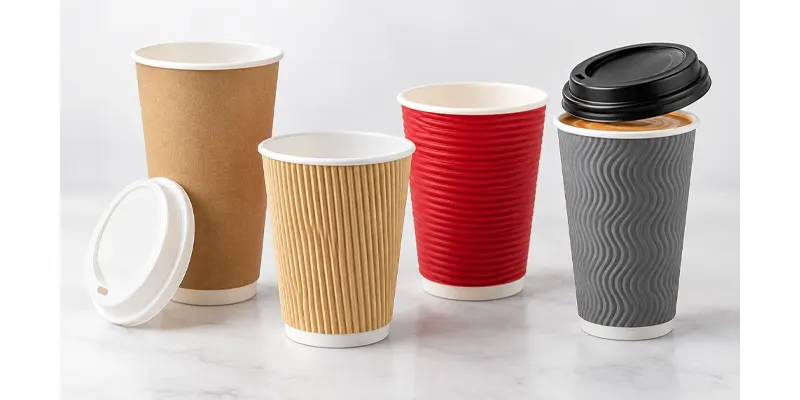
- Integrated Thermal Walls (Ripple & Embossed): Double-wall and multi-layer corrugated (ripple) designs are replacing the traditional “single-wall cup plus cardboard sleeve” combination. This reduces inventory SKUs for food service operators, cuts material handling waste, and improves heat retention.
- Foldable & Integrated Closures: The development of origami-style, foldable tops (often referred to as “butterfly lids”) creates an all-in-one drinking spout. This completely eliminates the need for separate plastic or molded-fiber lids, drastically cutting packaging volume and unit cost.
Paper and Fiber Materials
- Kraft and Alternative Fibers: Unbleached kraft paperboard is increasingly used when brands want a more natural appearance. Bamboo, sugarcane bagasse, and other alternative fiber blends are also being explored for selected cup applications. These materials can help brands create a different visual and tactile identity while diversifying fiber sources.
- FSC and PEFC Certification: Fiber sourcing is becoming more important in paper cup procurement. FSC- and PEFC-certified materials provide greater supply-chain traceability and help buyers demonstrate that fiber comes from responsibly managed or controlled sources.
Custom Printing
- Water- and Soy-Based Inks: Water-based, soy-based, and mineral-oil-free ink systems are receiving more attention in food packaging. They can reduce the use of certain solvent-based inks and help brands address concerns around VOCs, food-contact suitability, and compatibility with recycling processes.
- Short-Run Digital Printing: High-speed digital printing makes smaller production runs more practical. Independent cafés, regional chains, and foodservice brands can order seasonal designs, promotional cups, co-branded packaging, and limited-edition graphics without the same plate and setup costs required by traditional printing methods.
Smart Packaging Features
- QR Code Integration: QR codes are increasingly used to connect physical cups with digital information. Brands can use them for promotions, product stories, recycling instructions, local waste-sorting guidance, or deposit-return information, depending on the market.
- Better Rim and Lid Fit: Manufacturers are improving rim geometry and dimensional accuracy to create a more reliable fit with paper, plastic, or molded-fiber lids. Better tolerances help reduce leaks and spills, improve stacking consistency, and make cups more suitable for takeaway and food delivery.
Paper Cup Market Outlook to 2032
The global paper cup market is expected to continue growing through 2032, but future growth will likely be more gradual than in rapidly expanding packaging categories.
- Volume growth will remain steady but moderate.
- Market value may grow faster than unit sales.
- Asia-Pacific, the Middle East, and Latin America will contribute more new demand.
- Higher-value cup formats will increase their share of the market.
- Barrier coating technology will continue to develop.
- Regional production will remain important because of transport costs.
- Reusable packaging policies may limit growth in some mature markets.
The market is therefore moving from simple volume expansion toward a stronger focus on product performance, material efficiency, sustainability, and higher-value applications.
FAQs
Is the global paper cup market growing?
Yes. The market is expected to continue growing through 2032, supported by foodservice demand, takeaway beverages, and higher-value paper cup products.
What is the biggest challenge for paper cup manufacturers?
Strong price competition is one of the biggest challenges, especially for standard single-wall cups. Raw material costs and changing packaging regulations also put pressure on margins.
Will paper cups replace plastic cups?
Not completely. Paper cups are replacing plastic in some applications, but plastic, reusable cups, and other packaging formats will continue to coexist.
What certifications may matter for paper cup buyers?
Depending on the market, buyers may look for food-contact compliance, FSC or PEFC chain-of-custody certification, compostability certification, or other local packaging requirements. The required documents depend on the cup material and destination market.
Which paper cup products have better growth potential?
Higher-value products such as double-wall cups, custom-printed cups, cold-drink paper cups, and cups with improved recyclable barrier coatings are likely to attract more attention than basic commodity cups.
Conclusion
The global paper cup market is likely to grow steadily rather than rapidly. The strongest opportunities will come from emerging foodservice markets, higher-value cup formats, recyclable barrier solutions, and custom printing, while cost pressure and single-use regulations will remain key challenges. For buyers and brands, Million Pack can help match cup materials, structures, and printing options to specific market and application needs.