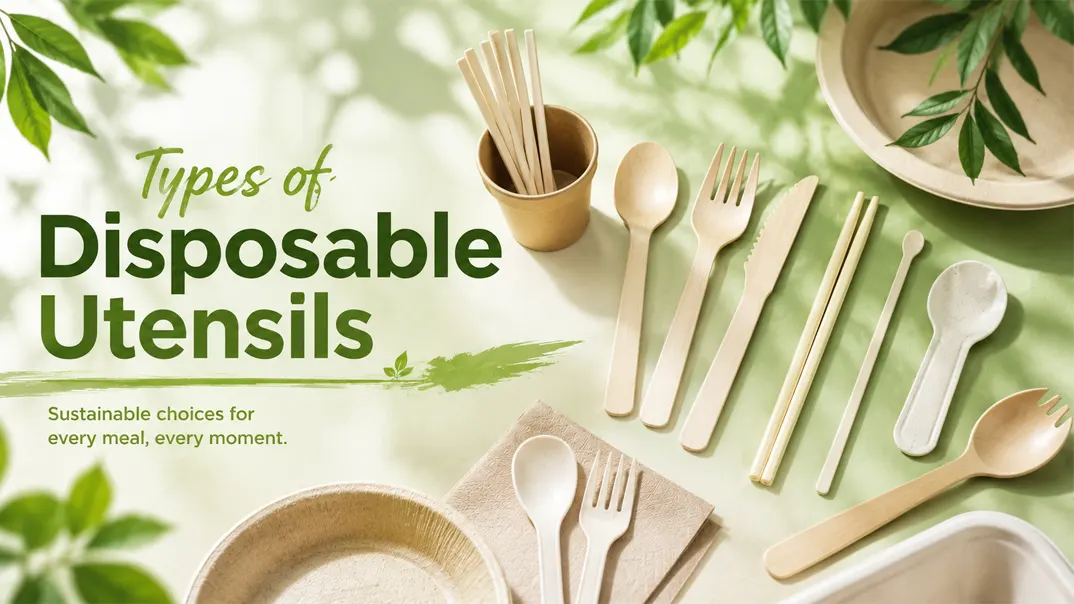
Disposable utensils come in many more forms than the basic fork, knife, and spoon. In foodservice, it can include sporks, chopsticks, tasting spoons, ice cream spoons, coffee stirrers, and serving utensils. Each type is designed for a different eating habit, food format, or service setting.
The materials used for disposable utensils also create different categories. Plastic, wood, bamboo, paper, PLA, CPLA, and plant fiber are all common options, and each one gives the utensil a different look, texture, strength, and environmental profile.
By the end of this guide, you will have a clearer answer to questions such as:
- Which disposable utensils is best for your business?
- What is the difference between plastic, wooden, bamboo, and compostable utensils?
- What should you check before choosing utensils for bulk orders?
What Do Disposable Utensils Include?
In foodservice, disposable utensils usually refer to forks, knives, spoons, and sporks used for takeaway, delivery, catering, events, and pre-packed meals. The category can also include chopsticks, dessert spoons, tasting spoons, ice cream spoons, coffee stirrers, and so on, depending on the food type and service setting.

Key Types and Components:
- Essential Utensils: Forks, knives, and spoons for standard meal service.
- Chopsticks: Common for sushi, noodles, rice bowls, and Asian takeaway.
- Specialty Utensils: Sporks, ice cream spoons, tasting spoons, gelato spoons, and mini dessert spoons.
- Beverage Accessories: Coffee stirrers, drink stir sticks, and small beverage spoons.
- Serving Utensils: Tongs, serving spoons, salad servers, pie servers, and cake cutters for catering or buffet service.
Types of Disposable Utensils by Material
Disposable utensils are no longer limited to traditional plastic forks, spoons, and knives. Today, consumers can choose from a variety of materials, each differing in strength, durability, cost, and disposal requirements. Before choosing a material, consumers should consider three practical questions: the type of food to be served, the strength requirements of the utensils, and how the used utensils will be recycled.
Plastic Disposable Utensils
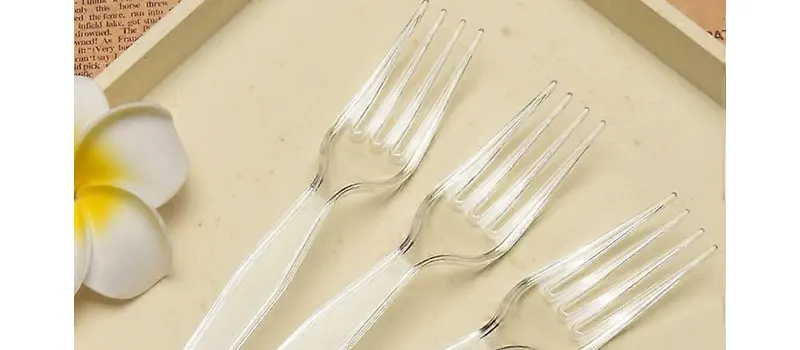
Plastic disposable utensils are usually made from food-grade plastics such as PP or PS. It is one of the most common materials used for disposable utensils because it can be molded into consistent shapes with different thicknesses, colors, and strength levels.
Plastic is often chosen when buyers need stable performance, low unit cost, moisture resistance, and a large-volume supply. However, its environmental impact and changing single-use plastic regulations have made many businesses reconsider where and how they use it.
Advantages:
- Lowest-cost disposable utensils option: Plastic utensils are usually cheaper than wooden, bamboo, CPLA, paper, or edible utensils, making it practical for large-volume use.
- Good moisture and oil resistance: Plastic does not absorb soup, sauce, oil, or moisture easily, so it keeps its shape better than paper or some fiber-based utensils.
- Multiple weight options: It can be produced as lightweight, medium-weight, or heavy-duty utensils, depending on the food type and service level.
- Wide design flexibility: Plastic utensils can be made in white, black, colored, glossy, matte, and other formats.
Disadvantages:
- Not biodegradable: Most traditional plastic utensils do not naturally break down in ordinary waste conditions and may remain in landfills or the environment for a very long time.
- Made from non-renewable resources: Conventional plastic utensils is usually made from petroleum-based materials, which are not renewable.
- Growing regulatory restrictions: Many countries, states, and cities have introduced rules limiting certain single-use plastic products, so buyers need to check local requirements before ordering.
- Can feel cheap if too lightweight: Thin plastic utensils may bend, snap, or feel low quality during use, especially with dense food or hot meals.
- Heat performance varies: Some plastic utensils may soften, bend, or deform when used with very hot food. The result depends on the plastic material, thickness, and product design.
Wooden Disposable Utensils
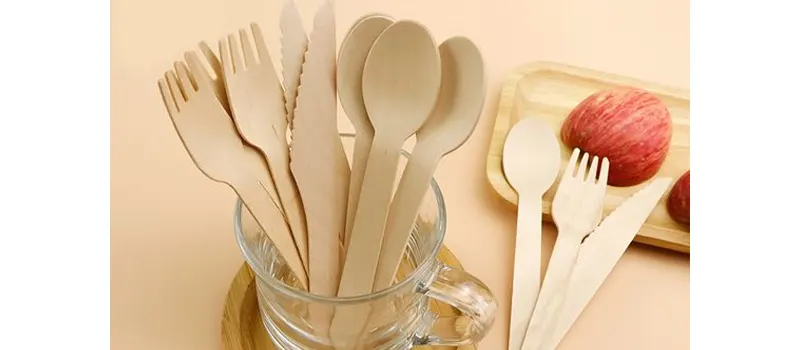
Wooden disposable tableware has a natural appearance and pairs well with takeout packaging such as kraft paper boxes and paper bowls. It’s ideal for environmentally conscious food brands.
The quality of wooden utensils depends on the wood selection, cutting precision, surface polishing, edge smoothness, and moisture control during production. Poorly polished wooden tableware may feel rough, so buyers should check its smoothness, thickness, and edge finishing before bulk purchases.
Advantages:
- Natural appearance: Wooden utensils work well with salad containers, bakery packaging, and dessert cups. It gives the whole meal presentation a more natural feel.
- Good rigidity: A well-made wooden fork, spoon, or knife usually feels firmer than lightweight plastic utensils.
- Better brand perception: Many customers connect wooden utensils with eco-friendly food packaging. It can help improve the perceived value of the meal.
Disadvantages:
- Mouthfeel may not suit every food: Some customers may feel that wooden spoons or forks are slightly dry in the mouth.
- Usually costs more: Wooden utensils are often more expensive than other utensils.
FSC-Certified and Responsibly Sourced
Our wooden disposable utensils can be supplied with FSC certification support and is made from legally harvested wood sources. This helps foodservice brands, distributors, and private label buyers choose wooden utensils with greater confidence, while reducing concerns about irresponsible sourcing or damage to forest ecosystems.
Bamboo Disposable Utensils
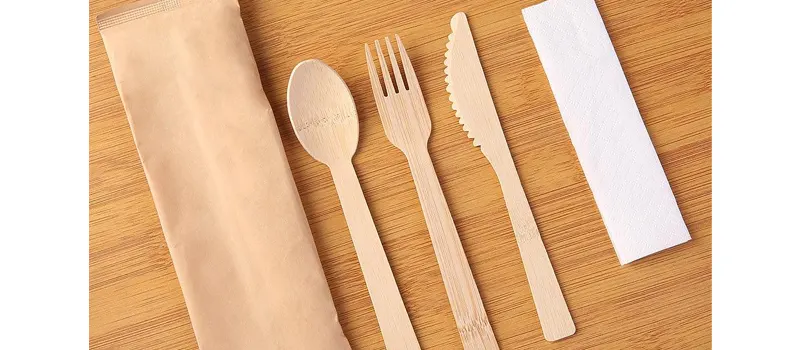
Bamboo disposable utensils have a natural and slightly premium appearance. It is often positioned as a natural, renewable, and more premium alternative to basic plastic.
Compared with standard wooden utensils, bamboo usually feels harder and denser. It can give forks, spoons, and knives better strength in daily foodservice use. However, bamboo utensils may also have natural color differences, so buyers should check samples before placing large orders.
Advantages:
- Strong material feel: Bamboo utensils usually feels firm in hand and can support many takeaway foods. It is highly waterproof and can be used for a long time without cracking.
- Natural and clean appearance: Bamboo has a smooth grain and warm natural color, which works well with kraft boxes, paper bowls, bagasse trays, and eco-style food packaging.
- Good heat resistance: Bamboo has a heat resistance temperature of 200℉. Bamboo does not easily soften when used with warm meals, noodles, or soup under normal foodservice conditions.
- Strong association with sustainability: Because bamboo grows quickly, it is widely recognized as a renewable material. This gives it strong appeal in eco-focused packaging lines.
Disadvantages:
- Natural color variation: Bamboo may show slight differences in color, grain, and texture between batches.
- Surface quality needs checking: Poorly finished bamboo utensils may have rough edges or an uneven touch, so buyers should check polishing quality and edge smoothness before bulk purchases.
PLA Disposable Utensils
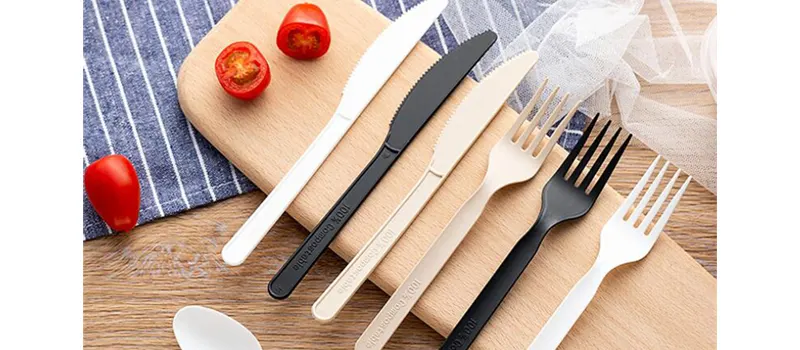
PLA disposable utensils are made from polylactic acid, a plant-based material usually derived from corn starch, sugarcane, or other renewable resources. It looks similar to traditional plastic, so it is often used to create a plastic-like appearance while reducing reliance on petroleum-based materials.
PLA utensils are mainly suitable for cold foods and room-temperature foods, such as salads, fruit cups, and desserts. It is not recommended for hot meals because PLA has limited heat resistance and may soften when exposed to high temperatures.
Advantages:
- Plant-based material source: PLA is made from renewable plant resources, which makes it a common alternative to petroleum-based plastic in eco-focused packaging programs.
- Better visual effects: PLA utensils have a smooth, plastic-like finish that gives cold food packaging a clean and professional look.
- Compostable under the right conditions: Certified PLA utensils can be commercially compostable, but it usually requires industrial composting facilities rather than home composting.
Disadvantages:
- Poor heat resistance: PLA is not suitable for meals packed at high temperatures because it may soften or deform.
- Composting depends on local facilities: PLA does not automatically break down in regular trash or landfill. Buyers should check whether the target market has industrial composting systems.
- Storage conditions matter: PLA should be stored away from high heat and direct sunlight. Poor storage may affect shape, strength, and shelf performance.
- Sustainability claims need proof: Buyers should check certifications, food contact compliance, and compostability standards before using PLA for eco-labeling or private label packaging.
CPLA Disposable Utensils
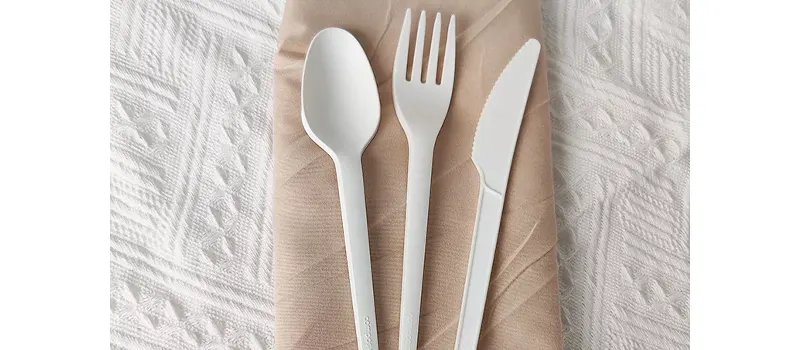
CPLA disposable utensils is made from crystallized PLA. It keeps the plant-based material background of PLA, but has better heat resistance after crystallization. This makes it more suitable for hot foodservice than standard PLA.
CPLA utensils is usually opaque and has a firm, smooth surface. Common colors include white, black, and natural tones. It is usually opaque and comes in white, black, or natural colors. For food brands that want compostable-style utensils for hot meals, CPLA is often more practical.
Advantages:
- Better heat performance: Its typical heat resistance is often around 85°C / 185°F.
- Rigid structure: CPLA utensils usually has a firm molded shape. This gives forks, spoons, and knives a more stable feel during normal meal use.
- Commercial compostable option: Certified CPLA utensils can support compostable packaging programs where industrial composting facilities are available.
Disadvantages:
- Limited flexibility: CPLA is rigid, but not very flexible. If the utensils is too thin or poorly designed, it may crack under strong pressure.
- Higher cost: CPLA usually costs more than many conventional disposable utensils materials.
- Requires industrial composting: CPLA does not compost effectively in normal landfill or home compost conditions.
- Limited color options: CPLA is usually available in simple opaque colors, with fewer visual choices than traditional plastic.
- Needs certification support: Food contact safety and compostability claims should be supported by proper test reports or certifications for the target market.
Paper Disposable Utensils
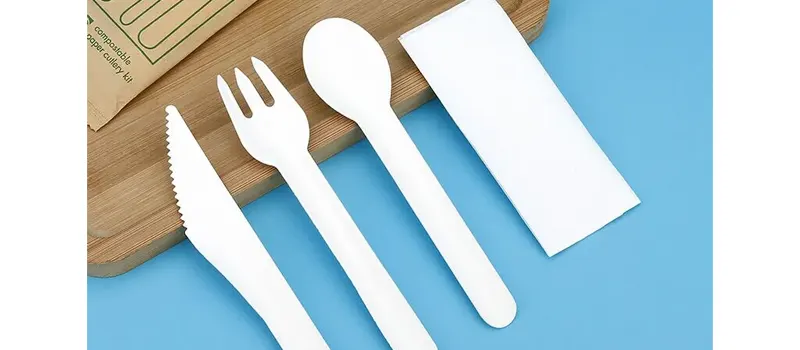
Paper disposable utensils is made from paperboard, compressed paper, or molded paper-based materials. It is usually seen in tasting spoons, small dessert spoons, and some lightweight forks or spoons. It is more often used when a brand wants a paper-based packaging look or when the utensil only needs to handle light, short-use service.
Paper utensils can be useful in certain situations, but it is not a universal replacement for plastic or wooden utensils. Its performance depends heavily on thickness, folding structure, coating, moisture resistance, and how long it stays in contact with food.
Advantages:
- Wide range of colors and design options: Paper utensils can be made in different colors, printed styles, and shapes, making it useful for themed packaging, children’s meals, dessert branding, and promotional events.
- Softer edges than rigid materials: Paper utensils usually has less sharp edges than hard plastic, bamboo, or wooden utensils. This can be useful in environments where reducing sharp edges is a concern, such as in prisons or hospitals.
- Lightweight and easy to pack: Paper utensils are usually light and flat, which can make them easy to include in sample packs, promotional packs, or compact food packaging.
- Can reduce the visual use of plastic: For brands that want to avoid a plastic-looking utensil, paper utensils offer a different appearance. This is mainly a presentation advantage, not always a performance advantage.
Disadvantages:
- Not durable: Paper utensils is generally weaker than plastic, wood, bamboo, or CPLA and can bend or lose shape during use. It can soften when exposed to soup, sauce, or wet foods, especially without coating or structural reinforcement.
- Not automatically eco-friendly: Paper-based does not always mean recyclable, compostable, or plastic-free. Some paper utensils may include coatings, adhesives, binders, or surface treatments.
- Quality varies a lot: A molded paper spoon and a thin folded paper utensil can perform very differently. Buyers need to check the actual structure instead of judging only by the word “paper.”
Bagasse or Fiber Based Utensils
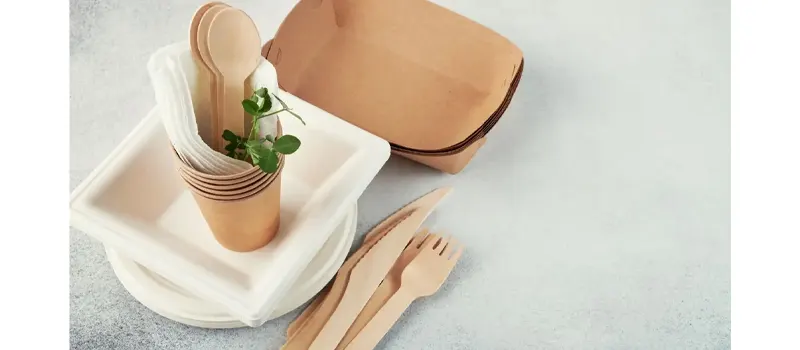
Bagasse and plant fiber-based utensils are made from fibrous plant materials rather than plastic resin. Bagasse usually refers to the fiber left after sugarcane juice is extracted. Other fiber-based utensils may use wheat straw, bamboo fiber, wood pulp, or mixed plant fibers.
This type of disposable utensils is usually formed through a molded fiber process. Its surface often looks matte and slightly textured, closer to molded pulp packaging than smooth plastic. Compared with PLA or CPLA, bagasse utensils do not have a plastic-like feel. Compared with paper utensils, it usually has more shape and thickness, but its strength still depends heavily on fiber density, molding quality, and product design.
Advantages:
- Made from renewable plant fibers: Bagasse and fiber-based utensils use agricultural fiber sources, which helps reduce reliance on petroleum-based plastic and supports a more eco-conscious brand image.
- Natural and premium appearance: The matte texture and visible fiber look give the utensils a cleaner, more natural feel than standard plastic utensils.
Disadvantages:
- Strength varies by product design: Fiber-based utensils may bend, crack, or feel weak if the material is too thin or the molding pressure is not well controlled.
- Moisture resistance may be limited: Some fiber-based utensils can soften when used with hot soup, oily food, or wet meals for a long time.
- Limited color options: Bagasse or fiber tableware is currently only available in its natural color and white. It is difficult to produce vibrant custom colors, so it may not be possible to meet the style requirements of all brands.
- Compostability depends on certification and local facilities: Fiber-based material does not automatically mean it can be composted everywhere, so buyers should check product certification and local waste collection conditions before making environmental claims.
Edible Utensils
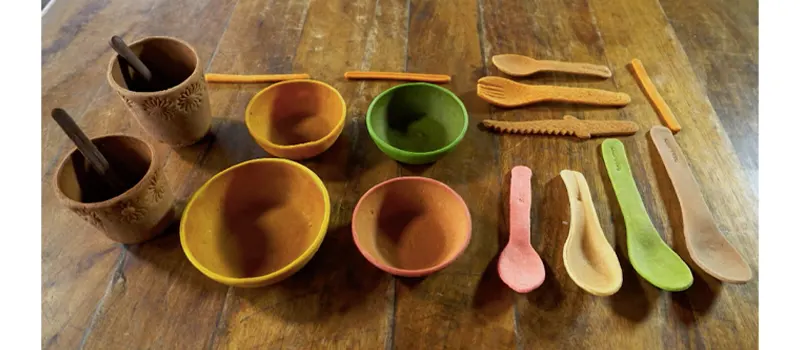
Edible utensils is made from food-based ingredients such as wheat, rice, sorghum, corn, oats, or other grain blends. It is designed to be used as a utensil first and then eaten after the meal, or disposed of as food waste if the customer does not eat it.
This type of disposable utensil is more common in desserts, ice cream, yogurt, tasting events, brand promotions, and novelty food service. It has strong marketing value, but it is not always practical for everyday takeaway because cost, taste, shelf life, and strength all need to be considered.
Advantages:
- Creates a memorable customer experience: Edible utensils feel different from normal disposable utensils and can make desserts, events, and promotional products more interesting.
- Reduces utensil waste when eaten: If customers eat the spoon or fork after use, it avoids the usual disposal problem of single-use utensils.
- Strong marketing appeal: It is easy to use in social media campaigns, eco-themed events, product launches, and food brands that want a more creative image.
Disadvantages:
- Higher cost : Edible utensils is usually much more expensive than plastic, wooden, bamboo, PLA, CPLA, or fiber-based options.
- Storage requirements are stricter: Edible utensils need proper moisture control, sealed packaging, hygiene protection, and shelf-life management.
- Not ideal for large-volume daily use: For restaurants, schools, airlines, or catering companies that need low-cost and stable supply, edible utensils is usually less practical than other disposable options.
How to Choose Disposable Utensils?
The selection of disposable tableware should be based on actual usage, not just the material name. For food service, suitable tableware can improve customer satisfaction, control costs, and support the brand’s packaging strategy.
Match the Utensils to the Food Type
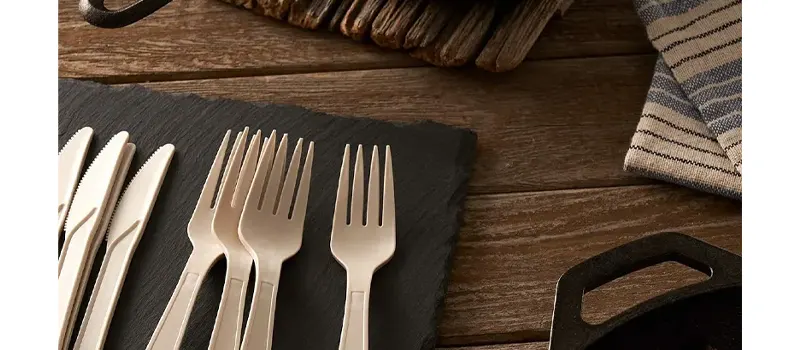
Start with the food your customers actually eat. Soft desserts need a smooth spoon, and salads need a fork that can hold ingredients well. If the utensils cannot handle the food, the material advantage becomes meaningless.
Check Heat Resistance Before Choosing
Hot food can deform weak materials. Standard PLA is better for cold use, while CPLA and heavy-duty plastic are more suitable for warm or hot meals. If your business serves soup, pasta, rice bowls, or takeaway meals, heat resistance should be checked before price comparison.
Consider Moisture and Oil Contact
Some materials perform well with dry food but become soft or weak when used with sauce, soup, or oily meals. Paper and some fiber-based utensils should be tested with real menu items before bulk purchase. For delivery meals, this is especially important because the utensils may stay packed with food for a longer time.
Choose the Right Strength Level
Lightweight utensils may be enough for tasting, desserts, or simple snacks, but it is not suitable for full meals. For dense food, meat, noodles, or large takeaway portions, choose thicker forks and stronger knives. Saving a small amount on weak utensils can lead to a poor customer experience.
Think About the Customer’s First Impression
Utensils are part of the meal presentation. Wooden and bamboo utensils usually give a more natural and premium feeling, while plastic is more practical for cost-sensitive use. If your food is positioned as healthy, organic, premium, or eco-conscious, the utensils should match that message.
Check Local Rules and Disposal Conditions
Before placing large orders, check whether your market has restrictions on plastic utensils or specific labeling requirements for compostable products. If you choose PLA or CPLA, confirm whether commercial composting is available in your area. Otherwise, the environmental claim may not match the real disposal process.
Compare Cost by Usage Value
Do not judge only by unit price. A cheaper utensil may break more easily, feel uncomfortable, or reduce the perceived value of the meal. For low-cost meals, simple plastic or wooden utensils may be enough. For premium takeaway, catering, or retail packs, stronger or better-looking utensils may be worth the higher cost.
Decide the Packaging Format
Bulk-packed utensils are suitable for self-service counters and back-of-house use. Individually wrapped utensils is better for takeaway, delivery, schools, airlines, and catering because it improves hygiene and distribution. For branded foodservice, printed sleeves or utensils kits can also improve the overall packaging presentation.
Test Samples with Real Food
Before confirming a bulk order, test the utensils with your actual menu. Check whether the fork bends, whether the spoon feels comfortable, whether the knife can cut properly, and whether the material changes after contact with heat, oil, or moisture. Sample testing is the easiest way to avoid choosing the wrong material.
Choose a Supplier with Stable Production
For restaurants, distributors, and private-label buyers, consistency matters. The utensils should keep the same size, thickness, color, finish, and packaging quality from batch to batch. A reliable supplier should also support sample checking, custom packaging, bulk supply, and basic food-contact documentation when needed.
Conclusion
Disposable utensils look like a small item in foodservice, but it often reflects an essential purchasing decision: cost control, customer experience, brand positioning, compliance risk, and waste responsibility all meet in one simple fork, spoon, or knife.
The real difference between plastic, wooden, bamboo, PLA, CPLA, paper, bagasse, and edible utensil is not just the material itself. It is how well that material fits the food, the service environment, and the customer’s expectations. A low-cost option may seem efficient at first, but it can weaken the overall dining experience if it bends, breaks, or feels too cheap. Good utensils makes food taste better.
If you still have any questions about choosing utensils, feel free to contact us. Million Pack will help you find the most suitable options based on your needs and budget.
FAQs
Which type of disposable utensil is most commonly used?
Plastic disposable utensils is still one of the most commonly used types because it is affordable, lightweight, strong enough for many meals, and easy to supply in large quantities. However, wooden, bamboo, CPLA, and fiber-based utensils are becoming more popular as foodservice brands look for alternatives with a more natural or eco-focused image.
Which utensils are better for cafés and bakeries?
For cafés and bakeries, wooden utensils is often the most balanced choice. It looks natural, feels clean, and works well with cakes, pastries, fruit cups, yogurt, and light meals. For a more premium presentation, bamboo utensils can be used. For tasting portions or short-use dessert service, paper or small wooden spoons are also practical.
Can I order different types of disposable utensils together?
Yes. Many buyers order different types of disposable utensils together to match different foodservice needs. Million Pack can help you combine different utensils materials, sizes, and packing formats into one purchasing plan.
Can you customize disposable utensils for my brand?
Yes. We support custom disposable utensil solutions for restaurants, distributors, food packaging brands, and private label buyers. Custom options can include material selection, utensil set combinations, printed paper sleeves, branded boxes, carton marks, and retail packaging.
What disposable utensils are best for catering and events?
For catering and events, bamboo utensils and wooden utensils are usually the best-looking options. They work well for weddings, outdoor events, corporate catering, buffets, and eco-style table settings.