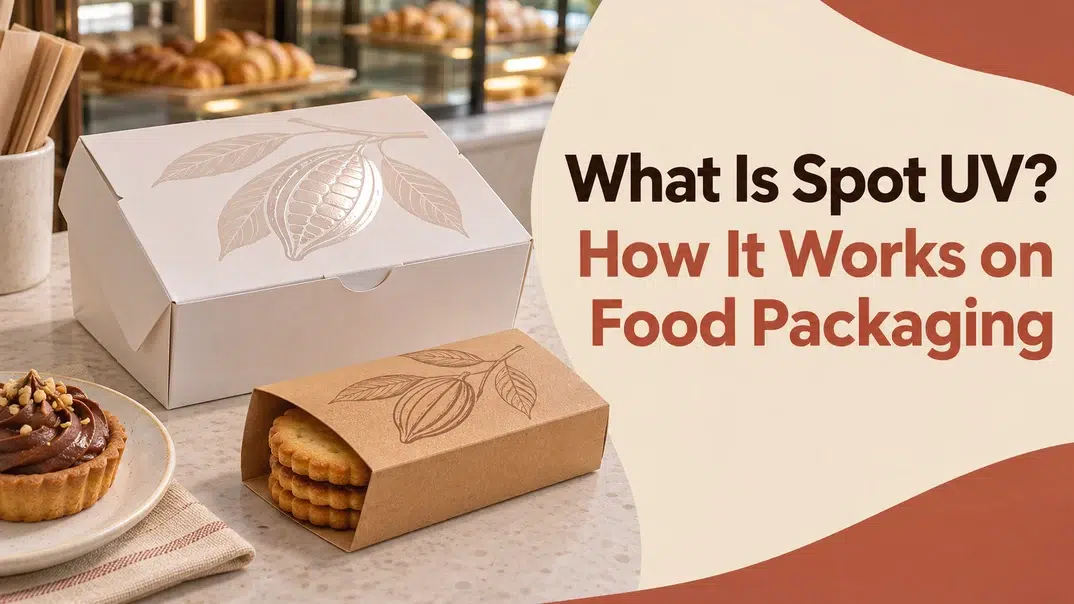
Spot UV is the glossy detail you see on part of a printed food box, often a logo or product name. The coating is applied only where the artwork calls for it and is cured with ultraviolet light. It draws the eye to selected details, but the result depends on the outer paper, the background finish and where the box folds. Before you pay extra for spot UV, take a closer look at what it is, how it works on food packaging, and whether that touch of gloss will help customers notice your brand.
What Is Spot UV?
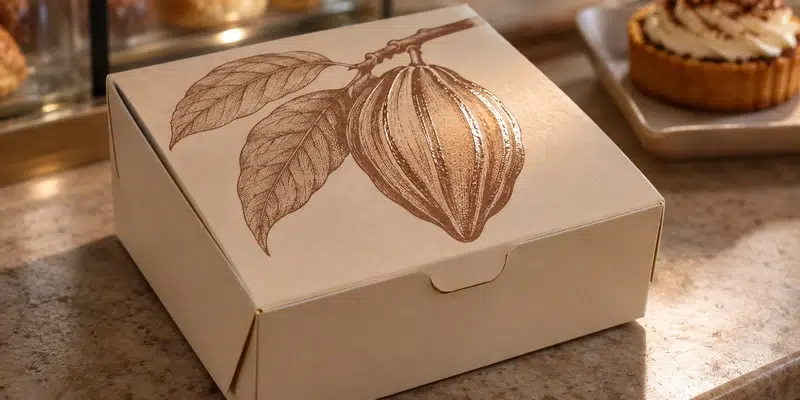
Spot UV is a packaging finish that adds gloss to selected parts of a printed surface. “Spot” means you choose which details to coat, such as your logo or a product name. “UV” refers to the ultraviolet light that hardens the clear coating.
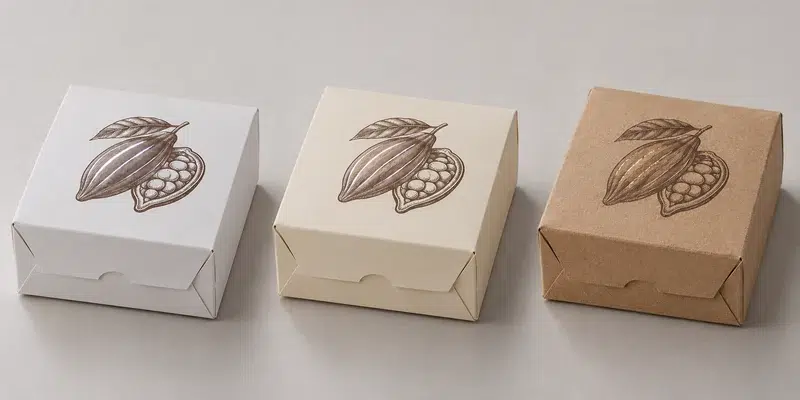
On a matte bakery box, for example, you might use spot UV to highlight a pattern of cocoa pods printed in the same brown as the lid. As a customer tilts the box, the coated pods catch the light and the pattern comes into view. The contrast comes from the shine, so you can bring out a detail without adding another ink colour.
How Is Spot UV Applied to Packaging?
The artwork needs a separate layer that marks the areas to be varnished. For a logo on a cake-box lid, that layer must align with the printed logo and the box dieline. It also needs clearance from creases, cut edges and glue areas where the finish could interfere with converting.
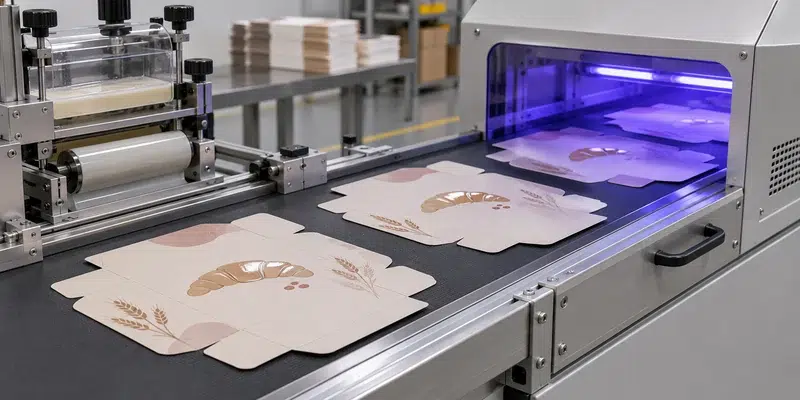
The usual sequence is straightforward:
- Print the base colours and graphics on the chosen paperboard.
- Prepare the outer surface if the ink, board and varnish combination needs a primer or another suitable finish.
- Apply the clear UV varnish through a screen, plate or digital unit to the marked areas.
- Cure the coating under UV light, then cut, crease and form the box as required by that production route.
The coating must land in register with the print. A slight shift is easy to notice when the gloss is meant to follow narrow letters or a fine border. That is why the varnish layer belongs in the production artwork, not in a note saying “make the logo shiny.” The manufacturer must also confirm that the selected coating cures and adheres on the actual ink and surface. A different board or outer finish can require a different setup.
What Does Spot UV Add to Food Packaging Design?
The main benefit of spot UV is that you can draw attention to a specific detail without changing your brand colours or redesigning the whole box. The gloss reflects light differently from the surface around it. On food packaging, that contrast can help customers notice your brand, recognise a flavour or appreciate a detail that makes a box feel more suitable for gifting.
Make Your Brand Name Easier to Notice
On a matte takeaway box, applying spot UV only to your logo gives the lettering a sheen while the rest of the lid stays matte. As a customer picks up the box, the change in reflection draws the eye towards your name. This is particularly useful if your bakery or café uses a restrained colour palette and wants its branding to stand out without making the logo larger.
Help Customers Recognise the Flavour They Want
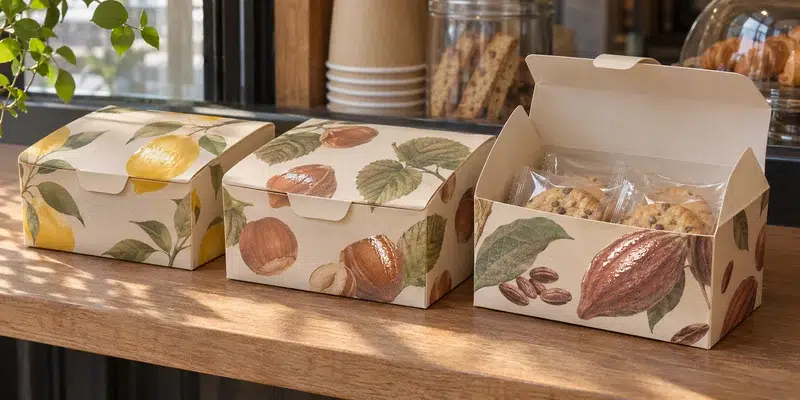
If you sell several flavours in similar cartons, spot UV can reinforce the detail customers use to tell them apart. On a biscuit range, for example, you could highlight the lemon illustration on one carton and the hazelnuts on another. The printed colours and flavour names identify each variety at a glance, while the gloss gives the relevant ingredient extra emphasis as shoppers handle the box. You can keep a consistent design across the range and still give each flavour a distinctive feature.
Give Gift Packaging a More Considered Finish
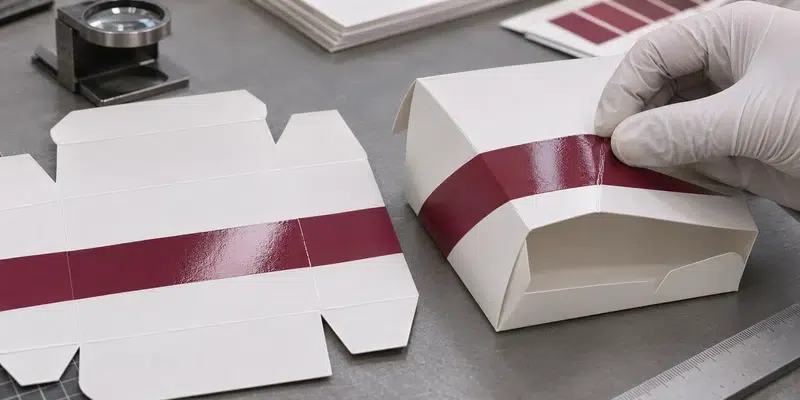
For chocolates, macarons or seasonal assortments, presentation is part of what the buyer is choosing. A clear gloss ribbon across a matte lid can catch the light as the recipient turns the box, giving the gesture of unwrapping a gift a visual counterpart on the packaging itself. Because the pattern comes from the finish, you can introduce a festive detail while retaining your familiar box colour. To judge whether it is worth the extra cost, compare a finished sample with a plain version under your usual display lighting. Look for a detail a customer can actually see and appreciate.
Add Texture Customers Can Feel
If touch is part of the design, specify raised spot UV. Standard spot UV primarily adds shine. The raised version uses a thicker coating that gives a logo or pattern a contour customers can trace with a fingertip. That detail has a clearer purpose on a confectionery gift box someone holds while lifting the lid than on a takeaway sleeve they handle for only a moment.
Which Food Packaging Materials Work Best for Spot UV?
For a crisp, visible gloss detail, smooth coated paperboard and matte-laminated paperboard are both good choices. The difference lies in the outermost layer of the box. On an unlaminated carton, the varnish sits on the board’s coated face. On a laminated carton, it sits on the film. Uncoated papers can give a subtler result, especially when the surface is rough or absorbent.
Coated Paperboard Without Lamination
If you want a small logo or fine lettering on a folding carton, start with paperboard that has a smooth coated face. The even surface helps the varnish form a clean edge. Choose a low-sheen board if you also want the gloss to stand out clearly. For a tea carton with a small brand name on the front, this gives you a practical option without adding a separate film layer.
Paperboard with a Matte Laminate
If you already want an all-over matte finish on a chocolate or dessert box, a matte laminate provides a uniform background for a glossy detail. The practical consideration here is the film itself. Ask your packaging supplier to confirm that the spot UV varnish adheres to the specific laminate you have chosen, particularly for a soft-touch finish. A sample made with that film lets you judge how the finished lid will look and feel.
Uncoated Kraft and Other Uncoated Papers
If you want to preserve the natural feel of an uncoated carton, test the varnish on the exact stock you plan to use. Absorbent paper can reduce the shine, while a pronounced grain can make fine lines look uneven. A sample showing both your smallest lettering and a larger solid mark will help you decide which details are worth coating. When ordering kraft board, check whether its outer face is coated or uncoated. The brown colour alone won’t tell you how the finish will look.
What Are the Limitations of Spot UV on Food Packaging?
Spot UV adds gloss in a separate step after the artwork is printed. That gives you control over which details shine, but it also means the result depends on how the varnish sits on the paper, how closely it lines up with the print and what happens when the box is folded. For food packaging, two other questions matter: whether the finish suits the intended food use and how much it adds to the cost of each pack.
Gloss Can Look Patchy on Absorbent Paper
Spot UV creates shine when the clear varnish forms a smooth layer on the surface. Uncoated kraft paper can absorb some of the liquid varnish before it hardens. If one part of the paper absorbs more than another, the same logo can look glossy in some places and dull in others.
Fine Lettering Leaves Little Room for Error
When spot UV follows a printed word, the ink and varnish have to line up. A slight shift may go unnoticed on a bold symbol, but on a thin script logo it can leave a shiny edge beside each letter. The smaller the lettering, the more visible that shift becomes relative to the width of each stroke. This matters most when the design depends on the gloss tracing an exact outline.
The Coating Can Crack at a Fold
A glossy stripe running from the lid of a chocolate box down the side can look continuous on the flat sheet. Once the carton is folded, the outer surface stretches around the corner. If the cured varnish cannot flex enough, it can crack and leave a visible break in the stripe. A flat artwork proof cannot show this effect. You can see it on a finished sample with the lid folded into position.
Date Stamps and Handwritten Notes Can Smear
Some stamp and pen inks dry partly by soaking into paper. Spot UV seals the area it covers, so those inks may stay wet long enough to smear when the next box is stacked or handed to a customer. The placement of the varnish determines whether this affects you. A glossy logo on the lid can sit alongside a date stamp on bare paper. The difficulty arises when your team needs to stamp the date directly over the gloss.
Food-Contact Suitability Depends on the Varnish and the Pack
“UV cured” describes how the coating hardens. Even for a design on the outside of a box, the varnish formulation and the way the cartons are produced matter. When flat cartons are stacked, for example, substances from the decorated face of one sheet can transfer to the food-facing side of the next. A box for loose pastries and an outer carton for individually wrapped biscuits therefore present different contact conditions. Suitability has to be assessed for the finished package and the food it will hold.
A Small Glossy Detail Can Still Add Noticeable Cost
A small logo uses less varnish than a full-panel pattern, but it can still require separate artwork preparation, setup and an additional production step. Making the logo half as large will rarely cut the finishing cost in half. Order quantity matters because the setup cost is spread across fewer boxes on a short run. If you are pricing a seasonal sleeve or a limited-edition gift box, compare quotes at your actual order quantity with the same board and artwork. The difference per box tells you what you are paying for the gloss and gives you a fair basis for deciding whether the effect is worth it.
Spot UV vs. Gloss Lamination, Foil Stamping, and Embossing
These finishes change different things. Use the result you want the customer to see or feel as the starting point:
| Finish | How it works | Distinctive features |
|---|---|---|
| Spot UV | A clear varnish is applied to selected parts of the printed packaging and hardened with ultraviolet light. | Only the coated details catch the light, so a printed logo can shine against a matte background while its original colour shows through. Standard spot UV adds little height. Raised spot UV creates a thicker detail you can feel. |
| Gloss lamination | A thin, transparent film is bonded to the printed side of the paperboard. | The entire laminated surface has a smooth, even shine. Printed colours can appear richer, and the film helps protect the artwork from scuffs during handling. |
| Foil stamping | In hot foil stamping, a heated die presses foil against the packaging, transferring the design onto the surface. | Metallic foils give lettering, borders or illustrations a reflective gold, silver or copper finish. Solid-colour and holographic foils offer other effects. The chosen foil determines the colour and appearance of the stamped detail. |
| Embossing | Two matching dies press the paperboard into a raised shape. | You can feel the design with your fingertips and see its contours as light falls across it. Blind embossing creates this relief in the board’s own colour, while registered embossing aligns the raised shape with printed artwork. |
FAQs
Will Spot UV Change My Brand Colour?
The varnish is clear, so the ink colour underneath stays the same. What can change is how you see it. A burgundy logo may look deeper than the surrounding print from one angle and pick up a bright reflection from another. If you use the same colour across several products, compare the finished box with a pack you already use under the same lighting.
Can I Use the Same Spot UV Artwork Across Several Flavours?
Yes, if the glossy detail stays the same size and in the same position on every carton. For example, if your bakery logo stays the same across three biscuit flavours, we can use one spot UV artwork layer for all three. If you want the flavour names themselves to shine, each name needs its own matching layer.
Is Spot UV the Same as UV Printing?
No. UV printing uses UV-curable ink to form the coloured image. Spot UV usually adds a clear coating to selected parts of an image that has already been printed. Both use UV light, but one makes the image and the other changes its surface finish.
Can Spot UV Be Applied Over Any Printed Colour?
It can be placed over many colours, but the appearance depends on the ink and the background. Gloss on a dark matte print may look strong; the same coating over a light or already shiny area may be subtle. Ink–varnish compatibility also matters, so compare finished samples on your chosen board before approving a colour-critical design.
Will a Digital Proof Show the Actual Spot UV Effect?
No. A screen proof can show where the coating is planned and whether it lines up with the artwork. It cannot reliably show reflected light, coating height or how the finish feels. For those decisions, examine a physical sample made with the proposed paper, print and finish.
Can Million Pack add spot UV to cartons I already have?
Possibly. The first thing we need to know is whether your cartons are still flat printed sheets, have been cut to shape, or are already folded and glued. A glued carton can lie flat in storage and still be difficult to feed through finishing equipment. Send us a photo, the dimensions, and any details you have about the outer coating. We can use those to assess whether your stock is a candidate and whether we need a physical sample to confirm.
Conclusion
Before you add spot UV to your packaging brief, ask one question: what would your design lose if you left it out? If you can name a detail that matters to your brand, you have a clear reason to highlight it. If the design already says what you want it to say, a simpler finish may serve you just as well. At Million Pack, we take a careful and thorough approach to helping you choose the right packaging solution for your needs.