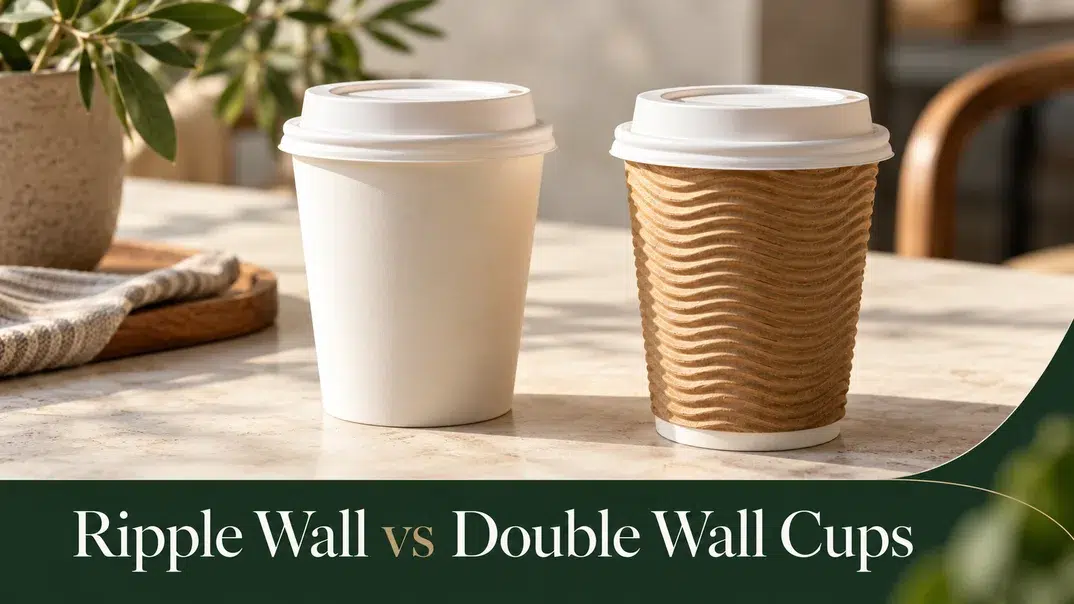
Ripple wall and smooth double wall cups both help customers hold hot drinks comfortably. Ripple cups use a corrugated outer wrap that adds air spaces and a raised gripping surface. Smooth double wall cups place a flat outer paper wall over an insulating gap. For a takeaway business, the choice comes down to the holding experience, the way the cup carries your artwork and the construction you are paying for.
How Are the Two Cup Walls Built?
Both have a liquid-holding inner cup and an additional outer paper wall. The difference is how that outer wall is formed. Here, “double wall” refers to the smooth version commonly listed alongside ripple cups in coffee cup ranges.
Ripple Wall: a Corrugated Outer Wrap
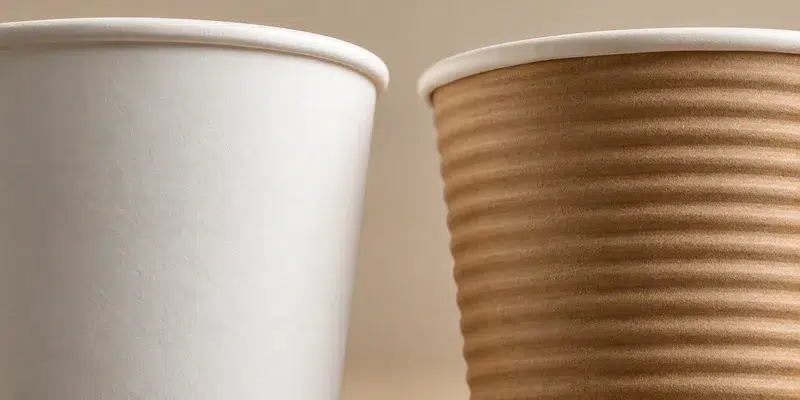
A ripple cup has an outer wrap formed into flutes: the raised ridges and recessed grooves you see around the body. This shaped paper creates air spaces in the wall construction and holds parts of the outer surface away from the inner cup.
The corrugated wrap is part of the finished cup. Its texture remains visible when the cup is plain or printed. The inner cup has its own lining and sealed side and bottom joints to contain the drink.
Smooth Double Wall: an Even Surface over an Air Gap
A smooth double wall cup places a second paper wall around the inner cup, with insulating separation between them. You touch the smooth outer sheet while the inner cup holds the beverage.
Ripple Wall vs Double Wall Cups at a Glance
| What changes | Ripple wall | Smooth double wall |
|---|---|---|
| Outer shape | Repeated raised ridges and grooves | An even outer paper face |
| Insulating geometry | Corrugated paper and the spaces it forms | Separation behind the smooth outer wall |
| Contact with the hand | Fingers rest mainly on the ridge peaks | Contact spreads across a continuous surface |
| Printed result | The surface pattern remains part of the artwork | Graphics sit on an uninterrupted background |
Which Cup Is More Comfortable with Hot Drinks?
Ripple gives you a textured hold, while smooth double wall gives you an even feel. Both can provide comfortable hot-drink handling through the combination of paper and insulating space in the wall.
Air Spaces and the Path Heat Takes
Small trapped air spaces slow heat passing from the inner cup toward the outside. Paper contact points provide paths for heat to cross between layers. The amount and arrangement of air and paper therefore matter alongside the number of walls.
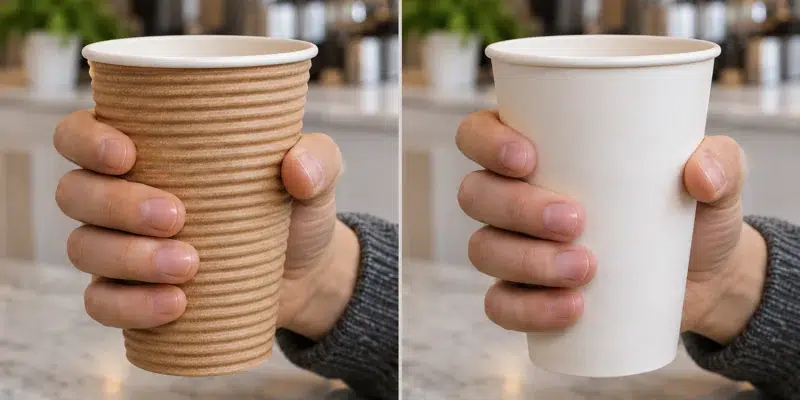
In a smooth double wall cup, the outer sheet covers the insulating space, so your hand meets a continuous paper face. In a ripple cup, the corrugation creates repeated spaces and raises parts of the surface. Your fingers mainly meet the peaks, with the grooves sitting farther from the skin. Ripple changes both the wall structure and the contact surface.
For a choice based on which cup feels cooler, compare the selected constructions at the same drink volume and serving temperature. Layer thickness, spacing and attachment points can differ within either family.
Texture, Cup Width and Firmness
The ripple pattern gives your fingers a surface they can feel as they close around the cup. Ridge depth and spacing change that contact: a broad wave and a fine corrugation create different holding surfaces. With smooth double wall, the feel is more uniform across the fingers and palm.
Diameter and taper determine how easily your hand wraps around either style. A capacity such as 12 oz describes volume, not the width at the grip. When comparing Million Pack options, keep the intended drink portion the same and check the body dimensions as well as the outer pattern. This avoids choosing a wider cup when the original problem was an awkward hold.
The outer wall also needs to stay in position under an ordinary filled-cup grip. Look for a wrap that sits securely against its intended attachment points and a body that keeps its shape when lifted. Movement between the wrap and inner cup, or a crease that lets the body buckle, affects carrying comfort even when the surface texture feels right.
How Does the Wall Change a Printed Design?
A smooth outer wall gives fine lettering, illustrations and large color fields a continuous surface. On a ripple cup, the raised pattern remains visible through the design.
Million Pack’s disposable coffee cup range includes printed ripple cups and vertical, twill, horizontal and wavy ripple patterns. A simple mark can work with the texture as the main visual feature. More detailed designs need enough readable space on the chosen surface, particularly around the seam and across the ridges.
Specify the pattern and paper finish with the artwork. “Printed ripple cup” alone leaves room for a different texture from the one you approved. For repeat orders, keep those details tied to the same sample and artwork version.
Check the formed printed cup at normal reading distance. Look at the smallest lettering, color on the specified paper and the placement of the wrap seam. Scan any QR code on that cup. A flat proof confirms the graphic file; the formed sample shows how the design works on the final surface.
What Changes the Cost of Each Cup?
The paper used in each layer, the work needed to form and attach the outer wall, printing and order quantity all affect paper cup costs.
Paper Weight and Visible Thickness Measure Different Things
Paper grammage, expressed in g/m² or GSM, tells you the mass of a square meter of paper. For a flat blank, area in m² multiplied by grammage in g/m² gives the paper mass in grams. Each layer of a cup contributes its own material weight.
Corrugation folds paper into a deeper profile, and the visible thickness includes the air spaces. To understand material use, compare the inner and outer paper specifications or the finished cup weight. To understand insulation, look at the wall spacing and construction.
Compare the Same Finished Cup Requirements
The formed ripple wrap has its own material and converting requirements. A smooth double wall cup has the costs of its outer board, forming and attachment. Paper grade, print coverage and production quantity can change the price relationship, so a general claim that one style is always cheaper is not a reliable quotation basis.
For a Million Pack comparison, identify the same usable drink volume, lining requirement, artwork and quantity, then compare the two outer-wall options. If the inner board or lining also changes, have that change shown in the specification. You can then judge whether you are paying for a different finish, a different inner cup or both.
Which Cup Should You Choose for Your Service?
Choose ripple when the raised texture is a feature you want customers to notice during handover and carrying. Choose smooth double wall when you want an even holding surface and artwork that reads continuously around the cup.
Our listed range includes 8 oz, 12 oz and 16 oz options in both families. Start with the portion and filling space your recipe needs, then compare the wall styles at that serving size. Keep the selected pattern, dimensions and artwork together when requesting the matching sample.
Before approving the order, fill the sample with your hottest usual drink at its normal level. Check the hold at handover and after a typical carrying interval, and inspect the inner cup for leaks over the intended use time. If you serve with a lid, confirm it on that exact rim. Record the approved material, wrap and print version so the order describes the cup you checked.
FAQs
Are Ripple Wall Cups Always Triple Wall?
No. Ripple identifies the corrugated exterior, and the layer construction varies by product. Million Pack lists a triple-layer ripple style separately. If your specification requires a particular number of paper layers, confirm the build of the selected model.
Which Cup Keeps Coffee Hot for Longer?
The wall style alone does not establish a winner. The sidewall is one route for heat loss; the top opening, lid, drink volume and surrounding air also affect cooling. Compare liquid temperatures over your normal takeaway time to judge heat retention separately from hand comfort.
Do These Cups Need a Separate Sleeve?
A sleeve may be unnecessary when the built-in wall gives comfortable handling with your drink. If a selected cup still feels too hot in normal service, compare another insulating construction or retain a sleeve. Include any sleeve you need in the cost per drink.
Can I Use the Same Lid on Both Styles?
Yes, when their rim dimensions and profiles match the lid. A shared ounce label does not establish fit: two 12 oz cups may have different rims. Check the chosen cup-and-lid combination before switching the wall format.
Are Ripple Wall and Double Wall Cups Recyclable?
Recyclability depends on the complete cup construction and the collection system available. Confirm the paper, lining, adhesive and print combination, then check what your local recycling program accepts. The smooth or corrugated appearance alone does not establish a disposal route.
Conclusion
Keep the approved finished sample and its material, wrap and artwork specification as your repeat-order reference. If any of those elements changes, compare the replacement with that reference before accepting it as the same cup.